
With the prevalence of blogs, Substack newsletters, and websites, what makes a good essay stand out?
This is a good question, and I won’t pretend it’s easy for writers to have their work read and engaged with, given the sheer volume of writing being published and self-published, especially online.
Speaking as a reader, the thing that makes any piece of writing stand out for me is the writer’s use of language. Sometimes this might be described as “voice”, but I think it’s more than tone – it has to do with whether the writer seems interested in language for its own sake.
I expect writers to be interested in language as a material, just like I’d expect a dressmaker to be interested in the qualities of fabric. Following on from this, a good essay is (to me) an essay that feels unique, as if it could have only come from that writer’s mind, with their particular confluence of interests and their particular engagement with language. It need not sit within the genre of ‘personal essay’, which I tend to think of as a first-person narrative that draws upon one’s own life experiences as material. A good essay can be an attempt to move away from the limitations of a self, as much as it may draw a writer into closer examination of themselves.
Research will always yield new angles and new information. How do you settle on the scope of an essay?
A question with no easy answer! I mostly find that I don’t know what I want to say, or even what I really think about a subject, until I write the essay. An argument tends to arrive for me simultaneously with the writing of it, and the essays I find most rewarding to write and to read are the ones where a train of thought leads you somewhere you couldn’t have predicted arriving at. Essays that begin from a settled premise and never move elsewhere are the least engaging, both to write and to read. So I would say: research until you have enough support material beneath you to be able to begin the writing. And then take a leap of faith – surprise yourself.
Which essayists, contemporary or otherwise, do you look to as a source of inspiration?
My favourite contemporary essayist is probably Terry Castle, whose book The Professor still makes me laugh out loud even though I’ve read it half a dozen times. I love Terry’s wit and panache, and her broad-ranging interests, from eighteenth-century literature to modern jazz.
How should essayists avoid coming across as self-indulgent in their writing?
Humour helps a lot. This doesn’t mean that all essays need to be comic, but being able to laugh at yourself, even in passing, is a sign of your ability to put yourself and your interests in perspective, and to see them from the viewpoint of the reader. I think this is especially true if you’re writing about a personal trauma – I’ve sometimes said to students, trauma is not intrinsically interesting. From your perspective as a writer the thing may seem of overwhelming significance, but your job as a writer is to make it interesting to someone outside of that experience.
What is your favourite line from an essay?
Essays are a cumulative form, they build an argument over time. Being drawn into that time as a reader, and dwelling there with the writer as they build something substantial, is what makes the form what it is. In that respect, I have no favourite line from an essay – I can’t even think of one off the top of my head.
Anwen Crawford is a writer and visual artist based in Sydney. She is the author of No Document (Giramondo, 2021), shortlisted for the 2022 Stella Prize, and Live Through This (Bloomsbury, 2015). Her essays and criticism have appeared in a range of publications including The Monthly, Sydney Review of Books and The New Yorker.
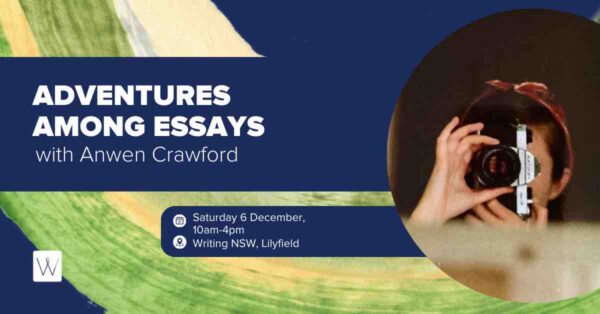
Join Anwen Crawford for her workshop, Adventures Among Essays, Saturday 6 December 2025, 10am-4pm at Writing NSW.
If you want to be the first to read great advice, prompts and inspiration from our incredible tutors, subscribe to our weekly e-newsletter Newsbite.
More from Writing NSW
Check out our full range of writing courses in Sydney, our online writing courses and our feedback programs to see how we can help you on your creative writing journey. Find out about our grants and prizes, as well as writing groups across NSW, and sign up to our weekly newsletter for writing events, opportunities and giveaways.