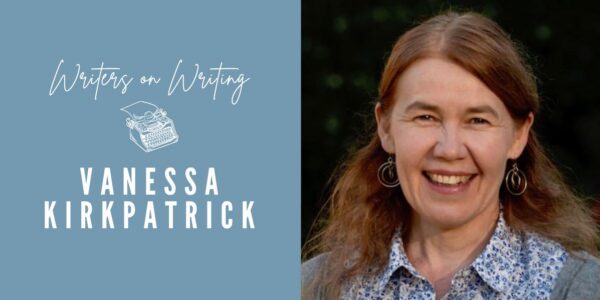
Writers on Writing is our regular conversation with a writer or industry professional about the writing craft, industry insights, and their own practice. This week, we spoke to Vanessa Kirkpatrick about her journey to discovering poetry, separating her ego from her writing, and the way poetry imprints itself in our memories.
What was your journey to writing poetry?
I fell in love with the musicality of poems, their sounds and rhythms, as a child, before I looked more deeply for their meaning. As soon as I could write, I started to fashion my own poems as a way of self-expression and making sense of experiences. I imitated the poets I admired. The turning point in my writing was being mentored by Deb Westbury. She taught me how to craft and refine my poems and to see the poems more from the reader’s point of view.
Was there singular moment when you realised you had found your poetic voice, or is the process much more gradual?
The finding of one’s poetic voice is a curious process as, to my mind, it is more an uncovering of what is already there. Learning always starts with imitation and finding my own poetic voice took place when I had read and imitated a lot of poetry and then found the courage to write what was true to me. I also needed to stop seeing my own words as a part of myself and to separate my ego from the poem. This is an essential part of crafting the poem as something to be shared with the reader, while still retaining your own personal style and the ‘feel’ of you. For me, this process was a gradual one and involved having the courage to write authentically.
What makes poetry particularly effective at communicating intense emotions or experiences?
To my mind, poetry is always yearning to be music as well as wanting to convey the most powerful but essentially inexpressible feelings and thoughts about human experience. In many poems, there is an overt tension between the desire to convey deep emotional experience as well as the frustration of coming up against the limitations of language.
Nevertheless, it is poetry that people often reach for at life’s significant turning points and liminal states: birth, marriage, illness and death, to name a few. The fact that poetry does not need to be linear makes it an apt vehicle for emotion and its musicality lends it a special quality not only because of its potential for beauty but also because of the way it imprints itself in our memories through patterns of rhythm and sound. When spoken aloud, as it was traditionally meant to be, poetry reminds us of the body – the rhythm is the poem’s heartbeat and the sounds are its breath and lungs. In addition, poetry’s power is enhanced by the ability of metaphor to convey emotion through imagery.
What do you love about metaphor?
I love metaphor as I see it as such a powerful vehicle for conveying emotion yet how this occurs is somewhat of a mystery. The act of putting two images or ideas together does so many things at the same time. Firstly, it heightens reader engagement by making the reader ask questions: what do these things have in common and how are they different? And how do these similarities and differences lend meaning to the poem? The kinds of metaphors that a poet uses, or their field of reference, usually draws on what the poet is most familiar with or interested in, so it gives the reader something of the poet’s mental and emotional landscape.
Vanessa Kirkpatrick is an award-winning poet and writer. Her first poetry collection, To Catch the Light, won the John Knight Poetry Manuscript Prize and was Commended for the Anne Elder Award. Her second collection, The Conversation of Trees, was published in 2017. Vanessa has a PhD in English literature and is an experienced teacher and creative writing mentor.
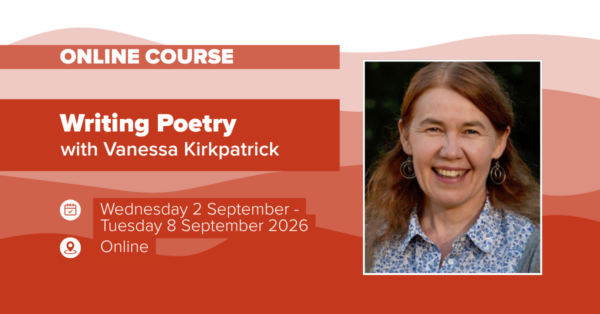
Join Writing Poetry with Vanessa Kirkpatrick, Wednesday 2 September – Tuesday 8 September 2026.
If you want to be the first to read great advice, prompts and inspiration from our incredible tutors, subscribe to our weekly e-newsletter Newsbite.
More from Writing NSW
Check out our full range of writing courses in Sydney, our online writing courses and our feedback programs to see how we can help you on your creative writing journey. Find out about our competitions and opportunities, as well as writing groups across NSW, and sign up to our weekly newsletter for writing events, opportunities and giveaways.