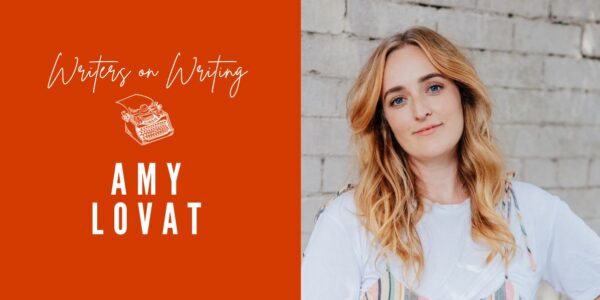
Writers on Writing is our regular conversation with a writer or industry professional about the writing craft, industry insights and their own practice. This week, we spoke to Amy Lovat about common writing pitfalls, the creative process behind writing a novel and the importance of giving and receiving feedback.
How has writing and editing two published novels given you a greater understanding (and appreciation) of your own creative process?
As I like to say to my students, it’s all well and good to want to be a writer, to aspire to write and be published and to envision that future… but you actually have to do the thing! To write a novel, you have to write a novel. It sounds ridiculous and obvious, but it’s genuinely something I remind myself multiple times a week. I have learned over the years that writing doesn’t happen when the rest of life is on pause… it happens among the chaos of life itself. Many people fantasise about taking time off work to write, winning the lottery, flying to a villa in Tuscany, and only then will the words flow. To burst your (and my) bubble, that is rarely possible. I have definitely benefited from the occasional long stretch of dedicated writing and editing time, like a self-imposed retreat at an Airbnb over a few days, or a week-long residency at Varuna Writers’ House. But more importantly, I’ve learned to write in small increments, in snatches of time, on my lunch break, in stolen hours here and there among paid work and parenting. Slowly, surely, piece by piece, bird by bird, the moments spent with my writing become pages, become chapters, become a novel. The greatest thing I have learned about my creative process is that it’s possible to actually have a creative process, even when life is full.
As an editor, you must see the same habits pop up again and again. What’s the writing ‘crime’ you spot most often, and have you ever caught yourself committing it in your own drafts?
Ah, so many! Overwriting is one that comes to mind: the urge to over-explain plot points and motivations and even physical descriptions to your reader, rather than trust them to follow you. But the one that has come up a lot for students in Year of the Novel is ‘head-hopping’: when the reader is granted unfettered access inside the minds of multiple characters, often at random. If you’re writing in omniscient third-person narrative perspective, that’s allowed, but should be used sparingly and masterfully. (I’m thinking here of Elizabeth Strout’s The Things We Never Say, which is a stunning example of when head-hopping works.) However, if you’re writing in limited or close third-person, when your reader is following the point-of-view of (usually) one main character, then we should only see the world through their eyes, and that includes the limits of their perspective. I’m happy to say that I’ve not caught myself committing the ‘crime’, predominantly because I’ve been writing in first-person perspective! But were I to experiment with third-person, I’d be watching my own writing behaviour carefully!
What advice would you give to writers who are still trying to develop a distinctive voice and style?
Just keep going – you’ll find it. And don’t try too hard. Let it come through gently, perhaps guided by one of your characters as you write to get to know them. I realise that sounds a bit like the annoying advice offered to single people: you’ll meet your soul mate when you least expect it (insert eye roll).
What is the purpose of feedback and how important is it for writers to be able to rely on a supportive network of peers to help them find the inspiration and drive to complete a full manuscript?
Of course, receiving feedback on your writing is equal parts exciting and terrifying. It can feel so vulnerable and it’s important to seek a supportive network of people who are like-minded and seeking similar goals. If you’re all in it together, working towards a complete manuscript, the process of giving and receiving feedback is more symbiotic and productive. You can hold each other accountable, commiserate and celebrate. Moreover, giving feedback on someone else’s writing can be one of the most valuable tools in your writerly kit. It teaches you so much about your own writing, when you can zoom out and read someone else’s drafts without the emotional attachment of your own work. That’s why a course like Year of the Novel, or joining a writer’s group, can be more valuable than sharing with other people in your life. Your mum or your best friend might have lovely things to say about your writing when you choose to share it, but is that going to progress your process? Don’t get me wrong: there will come a time when all you need is a push to keep going, a pat on the back and a couple of compliments. Friends and family are great in those circumstances (disclaimer: if you choose wisely!).
Amy Lovat is the author of Mistakes and Other Lovers (2023) and Big Feelings (2025), both published by Pan Macmillan. She has a PhD from the University of Newcastle where she’s taught creative writing and the humanities for over a decade. Amy is a professional editor and proofreader and has worked as a copywriter, subeditor and ghostwriter. She’s the current Artistic Director of the Newcastle Writers Festival, former Program Manager of Writing NSW, and founder of online bookstore and literary subscription Secret Book Stuff.
Join Amy Lovat for Online: Year of the Novel, February – November 2027.

If you want to be the first to read great advice, prompts and inspiration from our incredible tutors, subscribe to our weekly e-newsletter Newsbite.
More from Writing NSW
Check out our full range of writing courses in Sydney, our online writing courses and our feedback programs to see how we can help you on your creative writing journey. Find out about our prizes and opportunities, as well as writing groups across NSW and sign up to our weekly newsletter to stay informed.