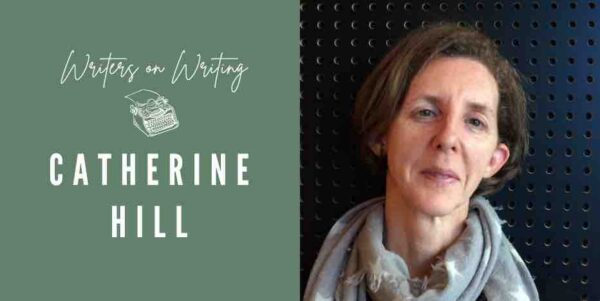
Writers on Writing is our regular conversation with a writer or industry professional about the writing craft, industry insights, and their own practice. This week, we spoke to Catherine Hill about what being an editor means to her, questions editors ask themselves in the first read of a manuscript, and the beauty of the author and editor relationship.
What does the title ‘editor’ mean to you?
To be literal, and a bit nerdy, it makes me think of its Latin root, which is ‘edere’, meaning ‘to put out’ or ‘to give out’, hence the idea of publishing.
In the US and the UK, the title or role is most often associated with someone who acquires for a publishing house, and then, initially at least, works with the author on the book acquired. That would most likely be editing broad-brush to pinpoint structural issues within the text.
In Australia, the title is more associated with the person who solely edits the work – the publisher being the person who acquires the work.
So for me, here, where I’ve spent the majority of my publishing career now, the title editor means someone who dives deeply into the text and does whatever is needed to make it the best version of itself.
When you first encounter a manuscript, what are the primary questions you’re considering before you formally begin the editing process?
I love the first read of a manuscript! Editorially, you encounter so much in that read, and it’s really the only time you will be in the same position as The Reader – although most of the time The Reader will, eventually, meet a quite different version of the manuscript.
I’m not sure there is a consistent set of questions I always ask myself or have to hand because, as in pretty well everything in editing, the issues and questions change depending on the genre, the author and the author’s experience and expertise. But I suppose the most foundational ones are: is this story or narrative working in its current form? (If the answer’s no, there are too many variables to go into here regarding the next questions!) Second, are things in the right order (it sounds reductive, but … obviously it’s important they are)? Third, are voice and character distinct? Fourth, what needs cutting and what needs expansion?
On my first read I try to strike a balance between absorbing myself in the narrative and marking anything that seems off, because frequently even on the second read, when you’re editing, you’re more accustomed to what wasn’t working so it likely won’t jump out in the same way.
What is your favourite thing about the editor and writer relationship?
Almost always my favourite part is building the relationship with the author. If I end up working on more than one of an author’s books, that’s even more rewarding as by then – hopefully – trust has built and you understand what the author wants and expects from an edit, how they respond to edits and what they give back, how far you can push them – all that tends to be a wonderfully rewarding back and forth.
I honestly can’t think of a better job most days – authors are almost all incredible people who create magic with their words. To me good writing is like some kind of extraordinary alchemistic talent.
Is editing a straightforward, formulaic process or does it change depending on a manuscript?
Every single manuscript we edit has some quirk, challenge, novelty to it. After twenty-plus years I am always amazed at how invariably this is the case. Like a piece of music, even the most apparently formulaic novel or piece of non-fiction is unique – because it has been written by a human being (accepting that, slightly terrifyingly, at this point in time this may be about to become a contestable statement), and no human mind is the same.
Even if you’ve heard the tropes in a story or the arguments in a narrative before, there is never an exact formula to the edit. I tailor my approach to each edit quite differently, depending on a multitude of factors, or perhaps simply instinctively working out how I will do my best and most useful work. So, while the world is changing at an alarmingly fast rate, and we are staring down the barrel of change in our industry, each edit remains its own different experience, depending on the manuscript.
That said, I will end with a bugbear of editors: when our work is conflated with that of a proofreader! The proofread is arguably more formulaic – super important but different from an edit.
Catherine Hill has been an editor of both fiction and non-fiction for more than twenty years. She started her editorial career in London, at Weidenfeld & Nicolson and then Little, Brown. She has worked in Australia since 2004, and is now Head of Adult Editorial at Penguin Random House.
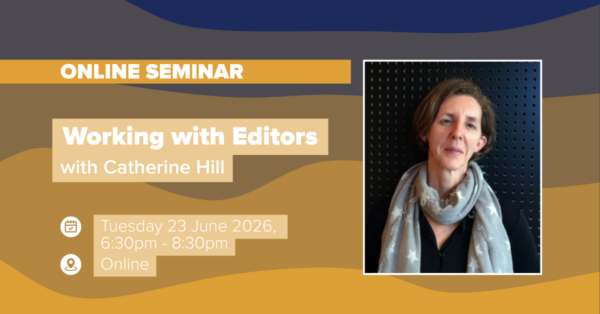
Join Catherine’ course, Working with Editors, Tuesday 23 June 2026, 6:30-8.30pm, online.
If you want to be the first to read great advice, prompts and inspiration from our incredible tutors, subscribe to our weekly e-newsletter Newsbite.
More from Writing NSW
Check out our full range of writing courses in Sydney, our online writing courses and our feedback programs to see how we can help you on your creative writing journey. Find out about our competitions and opportunities, as well as writing groups across NSW, and sign up to our weekly newsletter for writing events, opportunities and giveaways.