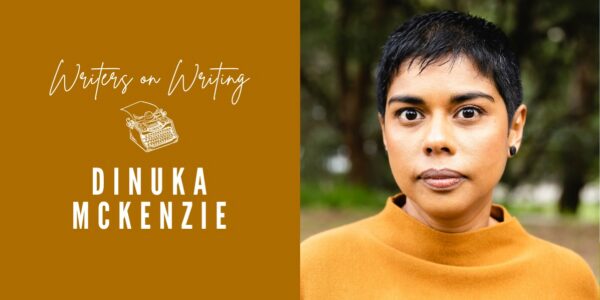
Writers on Writing is our regular conversation with a writer or industry professional about the writing craft, industry insights, and their own practice. This week, we spoke to Dinuka McKenzie about the unexpected journey of becoming a writer, engaging with darker aspects of human nature, and maintaining surprise and misdirection in crime fiction.
How would you describe your journey to publishing the award-winning Detective Kate Miles crime series?
In a word, unexpected. I never expected to become a writer. It was never in the cards or a dream of mine. Writing was something I fell into after becoming a parent, as a means of processing the complicated feelings I was experiencing about motherhood and all the expectations that went with it. What appeared on the page was a female detective, Detective Kate Miles, heavily pregnant and juggling motherhood and a career. A detective because crime fiction has always been my comfort read.
From that point, the road to publication was the path trodden by most writers: numerous rewrites, persistence, feedback, mentoring by other writers, learning about the industry, becoming part of the writing community, and a healthy dose of luck. For me, that bit of fairy dust took the form of winning the HarperCollins Banjo Prize, an unpublished manuscript award for commercial fiction, resulting in The Torrent, the first in the Detective Kate Miles series, making it to publication and onto bookshelves.
What are some reader and industry expectations surrounding crime novels?
As a genre, crime fiction gives both writers and readers explicit permission to engage with the darker aspects of human nature. To satisfy our fundamental curiosity to understand the who and how, but especially the why. It is what continually draws readers to the genre. A crime writer’s job is to deliver that story to a reader wrapped in a cracking puzzle with a dose of thrills and danger that keeps the reader coming back for more.
Does an understanding of the technical elements of crime fiction stifle creativity?
I would say the opposite. Writing books for a highly engaged audience who understands the mechanics of the genre, if anything, demands more creativity of a writer, in that we are always thinking about how to maintain the surprise and misdirection for a reader.
For a crime writer, the biggest compliment after literal months and sometimes years of developing a complicated plot is to hear a reader say: ‘I didn’t guess that ending’ and ‘I couldn’t put it down.’ Music to a crime writer’s ears.
What makes a well-rounded and compelling villain?
A character you may not agree with, but who you can’t stop thinking about after you turn the final page. Not cookie-cutter good or bad, but some version of the unending layers of grey in between. A crime writer’s role is to unravel the thread of how a person can end up where they do. To make readers ask themselves: How would I react in that situation? If circumstances were different, could that have been me?
How do you approach writing violence in crime fiction? Does it just exist as necessity of plot, or can it contribute meaningfully to a novel?
Violence, its perpetrators, the systems, cultural norms and social conditioning that allow it to flourish, minimise its impacts, or condone it, are all part of our everyday reality. For any writer (whether writing in the crime genre or not), depicting violence and its impacts on the page is a balance between the needs of the story and the harsh reality and darkness of what you are exploring. That line will be different for every writer and every reader. It is one of the broader topics I explore in my ‘Crafting Crime Fiction’ workshop and encourage emerging writers to think about in their own writing.
Dinuka McKenzie is the author of the Detective Kate Miles crime series, The Torrent, Taken and Tipping Point, published in Australia and the UK. She is the winner of the 2020 HarperCollins Australia Banjo Prize. Her writing has been shortlisted for the Sisters in Crime Davitt Awards, the Bad Sydney Crime Danger Awards, and longlisted for the Richell Prize. Her short fiction appeared in the 2022 Dark Deeds Down Under Crime and Thriller Anthology. Dinuka lives with her family in Southern Sydney on Dharawal country.
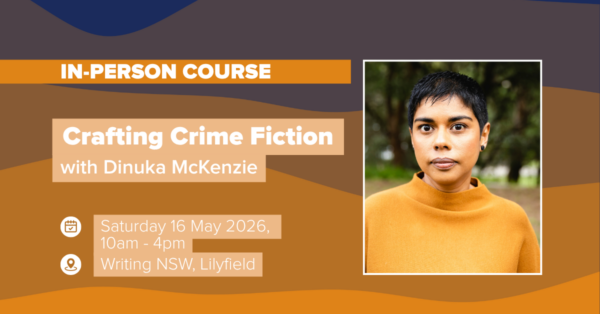
Join Dinuka’s course, Crafting Crime Fiction, Saturday 16 May, 10am-4pm at Writing NSW.
If you want to be the first to read great advice, prompts and inspiration from our incredible tutors, subscribe to our weekly e-newsletter Newsbite.
More from Writing NSW
Check out our full range of writing courses in Sydney, our online writing courses and our feedback programs to see how we can help you on your creative writing journey. Find out about our competitions and opportunities, as well as writing groups across NSW, and sign up to our weekly newsletter for writing events, opportunities and giveaways.