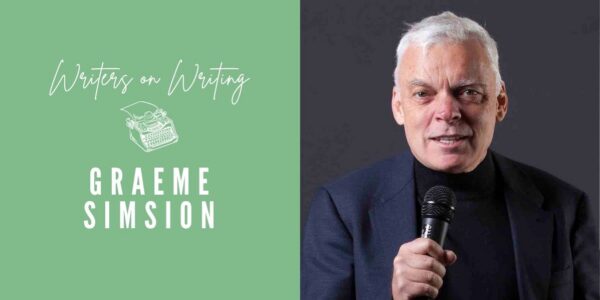
Writers on Writing is our regular conversation with a writer or industry professional about the writing craft, industry insights and their own practice. This week, we spoke to Graeme Simsion about how to approach the process of writing your first novel, what your writing routine should look like and what to expect in his upcoming course Demystifying the Writing Process.
Your first novel, the international bestseller, The Rosie Project, was published after you worked in IT for many years. How did you approach the daunting process of writing your first novel?
I worked on my writing for many years! I spent five years enrolled in writing courses, and throughout that time, The Rosie Project was my ‘school project’: whatever I was learning, I tried to apply it to my work-in-progress.
My previous career had given me some important transferable skills. I understood structure; I could give and accept feedback; I could organise my own work. But most importantly, I had an understanding of how much study and practise it would take to become competent. I worked hard because I knew I needed to if I wanted to make it as a writer.
I enrolled in a screenwriting diploma first. Despite having a lifelong dream of being a novelist, I didn’t think I was up to the task: screenwriting seemed more achievable. The course taught me a lot about story structure – more than most novel-writing courses.
While studying, I made ten short films. Seeing my scripts actually used gave me clear feedback on what was working and what wasn’t. When you see a scene that took hours to film hit the cutting-room floor – ‘don’t need this’ – you learn a powerful lesson. And it was as a screenplay that I first developed The Rosie Project. But I eventually realised that studios were looking for (bestselling!) novels to adapt rather than original screenplays.
So I enrolled in a novel-writing course, and wrote some short stories for publication – again, getting practise, getting feedback. Then I rewrote my screenplay as a novel. With a story and quite a bit of dialogue in place, I could focus on the prose (which I’d also practised), so the task that I had thought was beyond me was no longer so intimidating.
From your first novel to The General Hospital, what are some key lessons you have learned about the writing process?
The first thing is that you need to have a process. You need to know what it is and be ready to change or refine it in the light of experience. That’s one of the big differences between being a professional and a dilettante. And between starting the day knowing what you’re going to do rather than relying on serendipity. (And finishing it knowing you’ve made progress.)
I’ll talk about some of the principles of a good writing process on the course, but here are three:
- Most of us can’t do everything at once: plot, character, structure, tension, deathless prose. But we can do one thing at once. So my approach is to focus on one thing at a time.
- Creativity is something that can be incorporated into the process and managed day to day (I learned a lot in my PhD on creativity in IT and I’ve been able to apply much of it to my writing).
- Good writing is re-writing. You know that. But it goes further: every aspect of the process – plotting, character outlines, the title – benefits from revisiting. And being put aside for a while before doing so.
What do your regular writing routines look like?
I’m pleased that you said ‘routines’, plural. Because what I do on a working day depends on the stage of the project, and I may be running two or even three concurrently – perhaps proofreading one and planning the next while reviewing a screenplay that’s suddenly arrived in my inbox.
Most people’s idea of a writer’s routine centres around drafting – the picture of the artist bent over the typewriter. For me, that’s less than a quarter of my work.
I don’t write every day, but I work on my projects most days. Sometimes, that does involve actual writing, and I have a quite firm routine for that first draft; sometimes it’s editing, perhaps opportunistically as I wait to board a plane; sometimes it’s the stuff around writing like pitching, book events and answering interview questions. And sometimes it’s walking ten kilometres while I try to think of a better title.
You started your writing career later in life. What is your advice to writers who feel that it’s ‘too late’ to get started?
Take a step back, because they (and indeed aspiring writers of every age) need to ask the question: why do I want to write? The answer (and perhaps a couple more whys to follow up) will allow a more nuanced response than ‘it’s never too late’.
I was fifty when I made the career switch to writing. It took me five years to land a publishing contract, six to be making a living from writing. It took me about a week to be enjoying the process of writing, and in the time between I had short films made, had short stories published, had fun.
So: what do you want? Work it out and go after it, and don’t feel disappointed if you don’t achieve things that were never goals in the first place!
If you’re conscious that time is running out, make good use of it. Draw on your lifetime of experience for inspiration and for tools for getting things done. Enjoy the journey. If you find you’re not, ask the question again. Maybe you’d be happier painting.
What can I expect from Demystifying the Writing Process?
What I want you to take from the course is a process – mine, yours or, likely, a combination of the two – which will enable you to write the best novel, memoir, or bio that you’re capable of. I won’t teach you to write better sentences, but I will show you how to organise your work so that you begin each day knowing what you have to do, how to do it, and with confidence that you’re making progress towards a finished project.
What you can expect on the day is:
- Brief introductions – time will be at a premium. Come with one question you’d like answered and we’ll get that on the table from the start (of course there will be a chance for more later).
- An overview of the advantages of having a process, of working top-down (more or less) and of focusing on one thing at a time. It won’t be an extended argument: if you are a committed ‘pantser’, determined to make it up as you go along, this may not be the seminar for you!
- Some principles, tips on living the writing life and advice on managing the creative process. Plus we’ll look at the concepts of structure, as background rather than prescription (that’ll come later).
- The bulk of the course: A journey through the writing process, from premise to proofreading. We’ll follow the shape of The Novel Project – your take-away notes. It’ll be a helicopter view, but we’ll take the chopper down as we need to for examples and questions. At every stage, I’ll aim to give you at least one technique you may not have seen before: a tool for creating original premises; a way of exploring character; what instructions to give your beta readers.
We’ll do questions and discussions throughout. No exercises. No writing. It’s big-picture stuff. See you there.
Graeme Simsion’s books, including The Rosie Project series, The Best of Adam Sharp and Creative Differences and Other Stories have sold over seven million copies in forty languages. He lives with Anne Buist, his co-author for the Two Steps and Menzies Mental Health series, in Melbourne, Australia. The Novel Project was published in 2022 and has been widely praised by emerging and experienced writers.
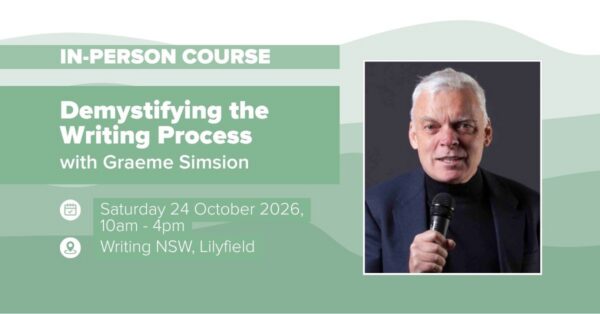
Join Graeme Simsion for Demystifying the Writing Process, Saturday 24 October 2026, 10am–4pm at Writing NSW.
Never ascribe to malice that which can be explained by incompetence.
If you want to be the first to read great advice, prompts and inspiration from our incredible tutors, subscribe to our weekly e-newsletter Newsbite.
More from Writing NSW
Check out our full range of writing courses in Sydney, our online writing courses and our feedback programs to see how we can help you on your creative writing journey. Find out about our prizes and opportunities, as well as writing groups across NSW and sign up to our weekly newsletter to stay informed.