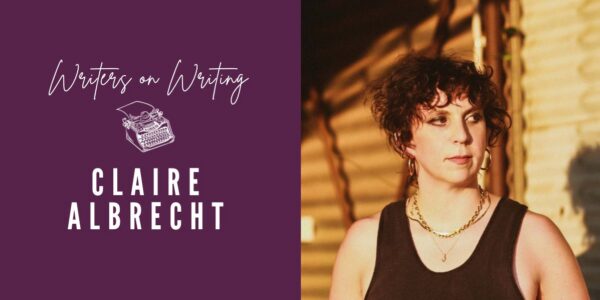
Writers on Writing is our regular conversation with a writer or industry professional about the writing craft, industry insights and their own practice. This week, we spoke to Claire Albrecht about how to maintain creativity and a sense of play in your writing.
What does writing an ‘unpublishable’ poem mean to you?
Writing an unpublishable poem means, to me, just having fun and enjoying the process of writing for itself, rather than as a vehicle for publication. Emerging writers can sometimes get hung up on writing something that editors will be interested in, which can be limiting both creatively and just in the sense of enjoying the act of writing. An unpublishable poem goes to the extreme of the other side—rejecting the industry and writing for play and exploration only.
As both a poet and an editor, do you feel a tension between creativity and the commercial business of publication?
Absolutely! When I was getting started, I had a spreadsheet that tracked journals and prizes with their submission date, whether I’d submitted anything, and the status (I also work in systems). I’m fairly sure I spent more time on that side of things than the actual writing itself. I’ve since stepped out of that submissions whirlpool and instead just write when I have something that I really want to write about.
What are some important ways that you safeguard your voice and authenticity as a poet?
I try to notice when I’m using expressions or styles that don’t feel like me, and rewrite until I can read myself in the work. I’m increasingly conscious of the writer behind the work, especially in the age of AI. What makes literature interesting is that it has come from someone’s mind, someone’s experience—it’s a reflection of their unique way of thinking, which belongs to them and no-one else. It’s a privilege to be let into that through good writing.
You started your writing career later in life. What is your advice to writers who feel that it’s ‘too late’ to get started?
Take a step back, because they (and indeed aspiring writers of every age) need to ask the question: why do I want to write? The answer (and perhaps a couple more whys to follow up) will allow a more nuanced response than ‘it’s never too late’.
I was fifty when I made the career switch to writing. It took me five years to land a publishing contract, six to be making a living from writing. It took me about a week to be enjoying the process of writing, and in the time between I had short films made, had short stories published, had fun.
So: what do you want? Work it out and go after it, and don’t feel disappointed if you don’t achieve things that were never goals in the first place!
If you’re conscious that time is running out, make good use of it. Draw on your lifetime of experience for inspiration and for tools for getting things done. Enjoy the journey. If you find you’re not, ask the question again. Maybe you’d be happier painting.
In your opinion, what do most ‘super-publishable’ poems have in common?
Well, that’s the thing. I believe a good editor picks out poems that are unique and don’t fit into the poetic trends or stylistic habits of the decade. Super-publishable poems are memorable. Maybe they’re a little bit weird, or do something unexpected. They’re evidence of play and of imagination. They invite us to explore how our own mind interprets things in unusual ways. They might not be perfect in terms of meter or structure or rhyme—generative AI can do those things flawlessly, but it doesn’t mean its poems are good (though sometimes they’re not bad, unfortunately). I guess this is a long way of saying that there’s no one definition of a super-publishable poem. There’s just lots of great poems that are waiting to get written.
Claire Albrecht is an award-winning poet and editor based on Wiradjuri Country, Australia. She was the 2019 Emerging Writers Festival fellow at the State Library of Victoria, a 2020 Varuna ‘Writing Fire, Writing Drought’ fellow, a resident at the Helene Wurlitzer Foundation, New Mexico in 2022, and a Varuna/The Bridge Awards Climate Fellow in 2024. Her work investigates connections between mental health, the physical environment, and technology. Claire’s manuscript sediment was shortlisted for the 2018 Subbed In chapbook prize, and her debut chapbook pinky swear launched in 2018. Her most recent book Handshake was shortlisted for the Puncher & Wattmann First Poetry Book Prize. Claire is Editor-in-Chief of The Suburban Review, Operations Manager of Red Room Poetry, and Manager of Australian Literary Studies.
Claire founded and ran Cuplet Poetry Night in Newcastle, which featured local, interstate and international artists and made a valuable contribution to Newcastle’s growing poetry scene.
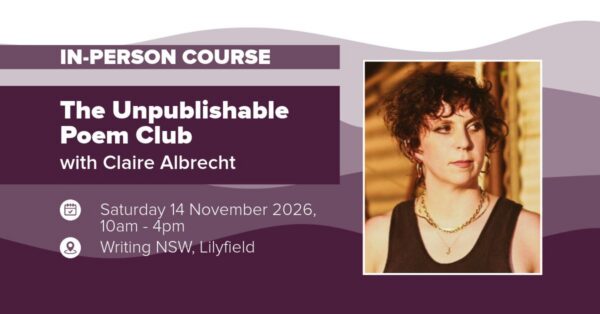
Join Claire Albrecht for The Unpublishable Poem Club with Claire Albrecht, Saturday 14 November 2026, 10am–4pm at Writing NSW.
If you want to be the first to read great advice, prompts and inspiration from our incredible tutors, subscribe to our weekly e-newsletter Newsbite.
More from Writing NSW
Check out our full range of writing courses in Sydney, our online writing courses and our feedback programs to see how we can help you on your creative writing journey. Find out about our prizes and opportunities, as well as writing groups across NSW and sign up to our weekly newsletter to stay informed.