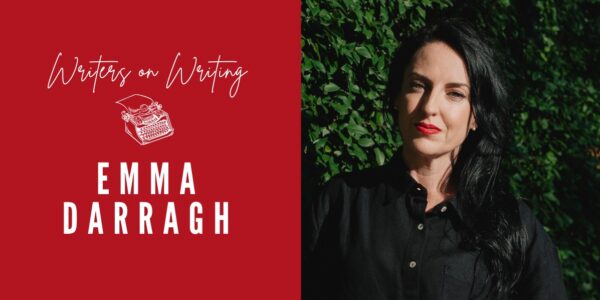
Writers on Writing is our regular conversation with a writer or industry professional about the writing craft, industry insights, and their own practice. This week, we spoke to Emma Darragh about writing fragmented narratives, interrogating our writing, and what to do when words get in the way.
Your most recent novel, Thanks for Having Me, is described as a ‘novel in stories’. How did you arrive at an episodic structure to your novel?
I’d already written a couple of stories about a pair of sisters growing up in the 1990s (Vivian and Susan) when I read Margaret Atwood’s Moral Disorder and Elizabeth Strout’s Olive Kitteridge. I loved the idea of creating a mosaic portrait of a character through multiple standalone stories, told from various perspectives and using various formal styles; so I rolled with it and wrote six stories about Vivian at various moments in her life. What started out as a playful experiment then morphed into a deliberate exploration of form as part of my PhD in creative writing. In my PhD dissertation, I use the term ‘short story cycle’ – which also implies a sense of return at the end of the book. I think this sense of return, as well as the fragmented, episodic structure (as opposed to straightforward linear storytelling) better suits the overarching concerns of my book: identity, family, and memory. I’m obsessed with short story cycles and other fragmented narratives.
Who is the first person that usually reads your stories? What kind of feedback do you ask for in those initial feedback stages?
I have a few trusted readers – one of my former supervisors (now a colleague), and a couple of friends I studied with. I love their writing and they really know their stuff. Still, I’m careful not to give anything to them too soon. I ask them quite broad questions in the early stages: How does it make you feel? What’s working? What isn’t working? Are you curious? Are you invested in these characters? And, most importantly: Do you want to keep reading?
Feedback can be difficult for writers, especially when they don’t feel like the aim of their writing has been understood. When is it good to kill your darlings, and when is it not?
As I mentioned above, I think it’s really important you don’t share your work (or your idea) too soon; you have to let the idea run wild for a while, to make your own discoveries before letting anyone else in on it. But there definitely comes a time when you need a fresh perspective.
Writing is first and foremost, communication. If your trusted reader doesn’t get it, it could be that a) they’re not the right reader for this work; b) you’re not doing enough to orient the reader in the world of your story; c) something (like one of your darlings) is getting in the way.
Every character and every scene – and every word, every piece of punctuation – should serve the story. If your reader tells you they were pulled out of the story because of a certain phrase or image, you owe it to your story to interrogate that phrase or image. Sometimes a really beautiful, musical sentence obscures what it is actually trying to describe – for whatever reason, the words get in the way. Are you showing off? Are you not trusting your reader? If the answer is yes, cut – or try alternatives.
If your trusted reader hasn’t told you why to kill that darling, don’t be afraid to ask them.
Having said that, I have resisted a couple of editorial interventions. One time an editor wanted me to make the description of another character’s eyes more concrete, for example, but in that moment, I didn’t want the focus to be on that character’s eyes themselves, but the feeling experienced by the narrator. It’s your story – you do have the final say!
(FYI, the darlings don’t ever really have to die… They can exist in their own separate document, waiting to be brought to life again in another project!)
What does your self-editing process look like? Do you edit your writing as you go, or do you reserve revisions until you’re finished a draft?
It’s… very messy! But I’ve learned that the messiness helps keep the pressure off.
I’ll often start writing by hand or will record voice notes – this material is edited as it gets typed into my document. Otherwise, I try not to edit as I go. It’s tempting to edit because it’s easier to edit than working on the blank page. That old ‘Write drunk; edit sober’ mantra is a good one.
I write in fragments and rarely do these come in chronological order, so there’s always a lot of tidying up to be done. As I’m working through a draft, I’ll write myself notes, make additions and highlight bits and pieces, rather than deleting or moving things around too much. It’s quite messy but it keeps the work moving. There’s no point copyediting or playing with the finer details of a scene if it ends up getting cut altogether.
I’ll then cobble together these fragments into a fresh draft. That draft will then get sent to my trusted readers for feedback.
Emma Darragh lives in Sydney on Gadigal Land and grew up in Wollongong, on Dharawal Country. She holds a PhD in Creative Writing from the University of Wollongong, where she has worked as an academic since 2019. Her work has appeared in numerous Australian publications, and her debut novel-in-stories, Thanks for Having Me, won the 2024 Readings New Australian Fiction Prize and was shortlisted for the Matt Richell Award for New Writer of the Year. An experienced writing coach and teacher, Emma enjoys mentoring emerging writers both in the classroom and through community-based programs.
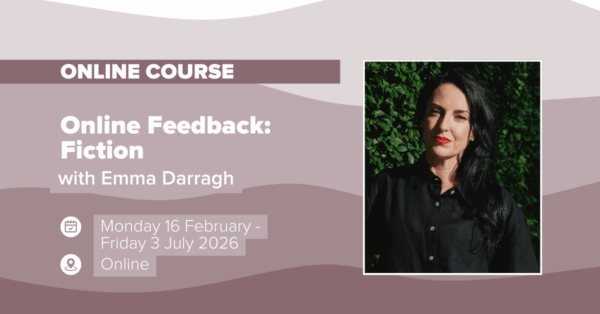
Join Emma Darragh for Online Feedback: Fiction, Monday 16 February to Friday 3 July 2026 (5 months), online.
More from Writing NSW
Check out our full range of writing courses in Sydney, our online writing courses and our feedback programs to see how we can help you on your creative writing journey. Find out about our competitions and opportunities, as well as writing groups across NSW, and sign up to our weekly newsletter for writing events, opportunities and giveaways.