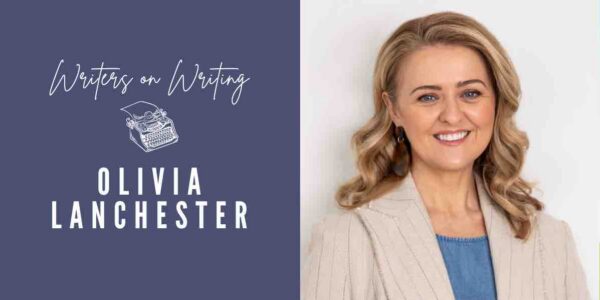
Writers on Writing is our regular conversation with a writer or industry professional about the writing craft, industry insights, and their own practice. This week, we spoke to Olivia Lanchester about navigating industry uncertainty and AI slop, how writers can protect themselves amidst the AI revolution, and the incredible cultural and creative power of writers.
As a policy consultant and intellectual property lawyer, what are some of the ways you’ve observed AI changing creative ecosystems?
My fundamental concern about the way AI is changing the creative ecosystems is the notion that we don’t pay for intellectual property anymore. I’m not being dramatic; the world’s biggest companies have done untold damage by propagating the notion that creative and intellectual labour is not worth paying for. The argument that “information wants to be free”, initially born with the internet, has been given new life by the launch of generative AI.
My other observation is the uncertainty felt in the industry as we navigate disruption and AI slop. For example, the relationship between authors and publishers is being strained in new ways. Authors want to know that a human is vetting the slush pile, editing their work, and illustrating and translating their books. Publishers want to be assured that a human authored the books they are investing in and putting forward for literary prizes. While publishers may embrace the efficiencies of AI in their operational workflow, data analysis and marketing, I think they must be worried about disintermediation (as AI can replace many of their services), AI-generated plagiarism, the challenge of discoverability in a crowded market, and, frankly, the ability to extract sufficient licensing fees from AI companies to compensate for the substitution and dilution effect of AI.
It’s interesting watching the market reaction to AI-generated books. We have internet sleuths uncovering the use of AI in the novel Shy Girl and the prize winning short story The Serpent in the Grove. I think the controversies that followed these discoveries show a rejection of AI in creative endeavours. Hachette withdrew Shy Girl from the market when allegations came to light that the author had relied heavily on AI. As AI is increasingly embedded in everyday software – such as Copilot in Word – a complete prohibition on AI use is unrealistic but guidelines will be increasingly introduced.
Publishing contracts now commonly require authors to give warranties about their use of AI. These warranties should go both ways with publishers and authors each agreeing permitted uses of AI. And every contract should ensure that the author’s work cannot be licensed to tech companies for AI training without the consent of, and appropriate remuneration to, the author.
Another big change since the launch of generative AI is the huge increase in self-published books on Amazon. At least 3 million out of the 4 million books published in the US in 2025 were self published. How many of these were AI generated? In a world increasingly filled with AI content, curation services – such as those provided by your local bookshop – will be even more valuable.
I suspect there’s little change in the way that writers practise their craft. Of course some authors and illustrators are using AI for administrative purposes and maybe as a sounding board or for background composition. But no one is using it to come up with anything ground breaking – even where AI is used as a tool, the originality comes from humans.
What are some small ways that writers can protect themselves from the AI revolution?
Firstly, I think creators are incredibly savvy about the ways in which AI is useful and the ways in which it is atrophying our brains. Understanding the efficacy of the available tools makes sense. Use them where they benefit you.
Secondly, writers need to be assertive in protecting their rights. Copyright is owned by you, as the author of your work. Initially, you hold all the cards. Don’t automatically give away all those cards when you enter into publishing contracts. If you don’t want your book fed into generative AI models, make that a condition of your contract. If you allow your copyright work to train generative AI models, then insist you be consulted on the licensing fee and agree on a minimum percentage of the resulting revenue. The more insistent authors are now, the more industry norms will emerge that are in their interests.
If you want to explore technical options to avoid your work being used for AI training, some artists use “anti-AI scraping” software such as Glaze or Nightshade and writers with websites might want to include “No AI training” clauses in their website terms and conditions, as well as adding a robots.txt file to their site. Authors are increasingly including an express notice on the imprint pages on their books prohibiting copying for AI training purposes. None of this is foolproof …but it is proactive!
Lastly, take joy in the creative process which cannot be taken away from you and which is the motivating factor for so many writers. In this industry, you need a bit of luck but it has always been the case that quality, compelling writing wins out, and it will be the case in the AI age too.
What is AI book slop and how can we identify it?
AI book slop is low-quality, AI-generated digital content which lacks meaning, usually designed for quick profit. To identify obvious slop, a discerning eye is all you need. Books that are AI-generated often seem “off”. They’re generally short in word count, with a generic looking cover, by an author with a vague bio and no digital footprint, published by a publisher you’ve never heard of, containing garbled or oddly bland text. Customer reviews can help. You won’t find slop in your local bookshop so that’s a good place to buy books!
What is your advice to authors feeling increasingly disheartened and disempowered by the rise of AI?
My advice is simple:
1. Stay focused on honing your own skills.
2. Value your own IP.
AI will significantly narrow the market for copy writing, freelance writing, graphic design and illustration in the corporate world. But it won’t replace the need for writers of books. We will always need original thought and original art and in fact may come to crave “humanness” more than ever. Over the last century, reading books has survived new technologies such as broadcast radio and television, the spread of suburban cinemas, the rise of digital gaming, and the introduction of social media. In fact, writing remains a vital skill as technologies evolve … from the radio plays of the past to the podcasts of today. We live in a fiercely competitive attention economy but we are also giving more time to consuming media than ever before.
Passionately defend your copyright which is the legal mechanism by which you are paid. Get advice on contracts. Support the advocacy of organisations like the ASA campaigning for government intervention against the extractive practices of multinational tech companies. Together, writers have incredible cultural power, capable of swaying public opinion and government action.
Olivia Lanchester is a cultural policy consultant and intellectual property lawyer. She is deeply experienced at advising authors and illustrators on all aspects of the publishing process, including publishing, agency and distribution contracts. Olivia was the CEO of the Australian Society of Authors from 2019 – 2024 and established Authors Legal, a national non-profit legal service for authors during that time. She is a former director of the Australian Copyright Council and International Authors Forum. Olivia was the Co-Chair of the industry group advising the NSW Government on its 2025 Writing and Literature Strategy. Olivia has led extensive advocacy on the impact of artificial intelligence on the creative economy. She is a director of Authors Legal and Chair of the Government’s Public Lending Right Committee.
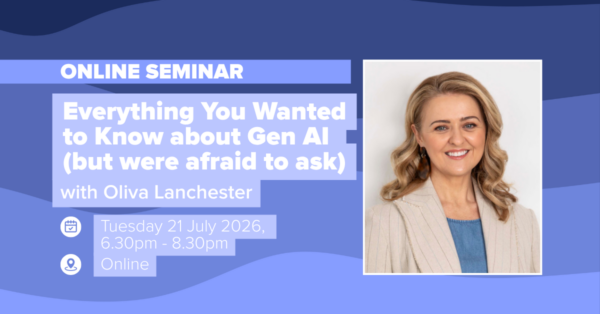
Join Seminar: Everything You Wanted to Know About Gen AI (but were too afraid to ask) with Olivia Lanchester, Tuesday 21 July 2026, 6:30-8.30pm, online.
If you want to be the first to read great advice, prompts and inspiration from our incredible tutors, subscribe to our weekly e-newsletter Newsbite.
More from Writing NSW
Check out our full range of writing courses in Sydney, our online writing courses and our feedback programs to see how we can help you on your creative writing journey. Find out about our competitions and opportunities, as well as writing groups across NSW, and sign up to our weekly newsletter for writing events, opportunities and giveaways.