In our Spotlight On series, we chat with a member of the Writing NSW community to celebrate their success and learn more about their writing practice. This month we chat with poet and editor Oormila Vijayakrishnan Prahlad.
Your next collection of poetry is being published by 5 Islands Press this year. What can readers expect?
My new collection is a poetic memoir about navigating complex family bonds, certain life journeys, and the movement from trauma recognition to healing. It is about the ordinary moments that shape a life entirely. The themes are personal but also universal: body image wounds, inherited generational patterns, and a few poems drawn from my experience as a war refugee during Desert Storm when I was a child. I have experimented with a range of forms in this collection. So there are zuihitsus, lyrical and imagistic pieces, and narrative poems. But they all reach for the same thing—examining the small events that have larger consequences.
5 Islands Press has championed Australian poetry for decades, and I am honoured to be part of this lineage!
Your first collection of poems, Patchwork Fugue, was published in 2024. How long was that in the making?
Patchwork Fugue took me four years to put together. It was my first adult collection, though I had published three collections of juvenilia earlier in my life and have been writing since I was seven. By the time I assembled it, I already had a large body of work to draw from, but it still took time to decide which poems to include.
When I joined Black Bough Poetry UK’s community of poets in 2019, that body of work found a clearer formal direction. Under the mentorship of editor Matthew MC Smith, I began publishing more consistently, and a stylistic cohesion started to emerge.
The poems in this collection are experimental, exploring time, memory, and the body, often returning to these themes from different angles. The idea of a fugue felt right early on—voices overlapping voices like counterpoint, and it shaped how I ordered the manuscript. It was published in Wales by Atomic Bohemian Press with the support of Bangor University.
You have appeared in over 70 collections around the world. What do you attribute this energy to?
I am a very solo creature who spends a lot of time alone. When I am not working, I will be in my studio either writing or painting. I wake up with lines and images in my head that I follow to see where they will lead. I have a lot of art and poetry filed away that need homes! So over the years, pitching to journals and anthologies just became a natural progression of having a large body of work.
Getting an acceptance is wonderful and I always celebrate when a poem or artwork is placed. Beyond that there is also the wide reading that happens as part of the submission process. You have to know a journal inside out, which means you have to read the archives thoroughly. Pitching work to journals in the US, UK, The Netherlands, Canada, and Germany means understanding different editorial styles and how your work fits in dialogue with varying sensibilities. That process of learning and evolving itself keeps the momentum going.
For me, it has also been about making friends. Actively submitting and placing work means meeting new poets, editors, and being part of a growing international community of like-minded writers who connect over shared work. That has also kept my motivation up.
In addition to this, you are also a ‘slammer’ – winning the Bankstown Poetry Slam last year. What’s the difference between slamming a poem and doing a reading?
I see doing a reading and slamming as different ways into the same poem rather than different kinds of poems. I’m interested in how a piece moves across the page and stage, how it sounds, how it lands. And different audiences can have completely different reactions to the same poem! I do think certain poems work better for the stage, and others shine more on the page, but that’s a personal thing.
I think of a reading as a quiet conversation with the audience. There’s space for nuance, for things that might not carry as easily in performance, like experimental lineation or dense language. Slam has a different kind of immediacy. Your poem has to live, breathe, and burn in the moment. The room becomes one big living organism that is part of your performance, snapping fingers, drumming feet, ooh-ing, aah-ing. You head into slam using everything: voice, pace, gesture, presence, even what you wear. If I’m reading an urgent poem, I wear red. Hopping on stage for a slam competition is like the ultimate dare!
My slam style leans towards poetic storytelling, so I tend to choose narrative, more linear pieces. The Bankstown Poetry Slam at the 2025 Sydney Writers Festival was electric. I performed The Land Never Asks, a love letter to the Gammergal land I live on, about my experiences of migration and assimilation. There were close to a thousand people at Town Hall that night, and the energy was indescribable. I was honoured and genuinely gobsmacked to win.
You were a founding editor of Authora Australis, a new literary journal. What made you want, and then publish, a new journal?
When I moved to Sydney in 2015, the first friends I made in the city were writers at The Marrickville Writers Corner, run at The Gasoline Pony, by academics Roger Patulny, Sukhmani Khorana, and Carlo Capponechia. The group quickly grew to a diverse community of poets and writers. After readings and open mic events, a literary magazine seemed like the next logical step. Roger and Carlo invited me on the editorial board, and we set up Authora Australis to create a platform for other writers from all over the world to showcase their art and poetry. The idea of themed issues was also something we liked. There is a particular challenge to imposing thematic constraints. I think it makes writers seriously consider the theme and approach the familiar from new angles.
What did you learn as an editor and publisher that now informs your work as a writer?
Reading hundreds of submissions, you begin to notice in the first few lines itself if the poem is aware of what it is doing. The language and logic have to hold the reader’s attention from the start. On the page there is nowhere to hide. Artistic decisions have to be intentional, from the choice of words, to lineation, to the use of white space and even fonts.
After years of editing, I am now very brutal with my own first drafts. I have become a cold-blooded exterminator of my darlings! Occasionally I do cry when I have to let a phrase I love go from a poem. I save those bits for another poem. But there can be absolutely no compromise between intent and landing. As an editor I became tuned in to identifying parts for potential revision in other writers’ work. As a result of that I have become good at spotting the wobbly parts in my own writing.
Turning to look at your work, many of your poems exist on a border of the real and mystical/spiritual. Concrete experiences of sight, smell, touch are lifted, almost metaphysically, into another realm. Where do you find the language to achieve this?
I think it comes from two things: multilingualism and my painting practice.
I was raised in the Middle East in a very traditional South Indian Hindu household, and later lived in India and Singapore before moving to Australia. I’m constantly code-switching between languages, and cultural and social norms, and that carries into my writing. Even though I write poetry only in English, the other languages I speak shape how I think, through idiom, rhythm, and ways of seeing. That sometimes leads to unusual metaphors and sentence structures, which I like to lean into.
I’ve also been a painter for over thirty years, and that has influenced how I approach imagery. When I’m painting a scene, it’s not just visual, I’m thinking about texture, movement, atmosphere. I try to bring that same sensory layering into my poems.
Today, I consider myself an agnostic pantheist, but the religious and spiritual traditions I was raised in still linger in the background. For me, everything is connected and extends beyond the immediate sensory world. That’s what I try to reach for when I write or paint.
What is your next project?
I have a full-length collection about my migration journey that is about three-quarters complete. This year marks eleven years since my family and I moved to Australia, and I find myself wanting to map what that transformation actually looked and felt like from the inside. It’s about finding a sense of belonging, about raising children in a newly adopted home that has open-heartedly embraced me.
It’s also about what it means to be Australian and becoming the writer I always wanted to be. For me, those two things happened simultaneously. Australia gave me the right conditions, the writing community, and the courage to go all out. The working title is The Land Never Asks, which comes from the poem that won first place at the Bankstown Poetry Slam. It struck me that the land doesn’t ask where you’re from, or whether you’ve earned your place. It simply receives you. After eleven years, I think I’m finally ready to talk about what that receiving has meant in its entirety.
I’m also headed to Magdalen College School, Oxford, in July, where I’ve been invited to read as part of the Oxford Poetry Circle, at the Oxford Festival of the Arts. I’ll be doing a short spoken word tour in London as well.
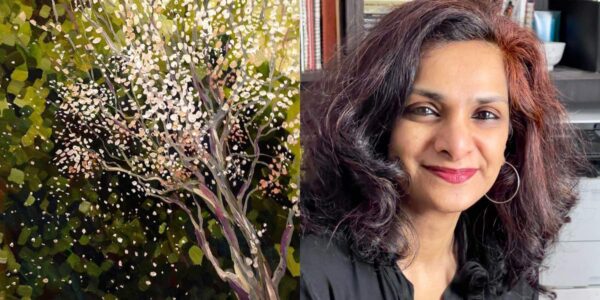
Image: On the Wind, Oormila Vijayakrishnan Prahlad. Acrylic on canvas-grain paper, 36″x24″, 2015.
Oormila Vijayakrishnan Prahlad is an Indian-Australian artist and poet with works in Cordite, Black Bough Poetry UK, The Salons, Poetry Sydney, and other publications. She has performed internationally, including at Oxford Poetry Circle and the Surrey Laureate Lounge. She won the 2025 Bankstown Poetry Slam (Sydney Writers Festival) and the 2025 Bread and Butter Slampionship at the Opera House. A multiple Pushcart Prize and Best of the Net nominee, she is the author of Patchwork Fugue (Atomic Bohemian Press, UK 2024) and A Second Life in Eighty-eight Keys (Hedgehog Poetry Press, UK 2024, winner of the Little Black Book Competition).
Her new collection is forthcoming from 5 Islands Press (2026). Her artworks have been published on the covers of Yale Divinity School, Pithead Chapel, Amsterdam Quarterly, and numerous other literary magazines. She is the inaugural Writer-in-Residence at Woollahra Libraries.
She lives and works in Lindfield, on the traditional lands of The Eora Nation.
Learn more about Oormila here, or follow her on X, Instagram or Facebook.
Read about past Spotlight On writers here.