In our Spotlight On series, we chat with a member of the Writing NSW community to celebrate their success and learn more about their writing practice. This month we chat with author, illustrator and artist, Yvonne Low.
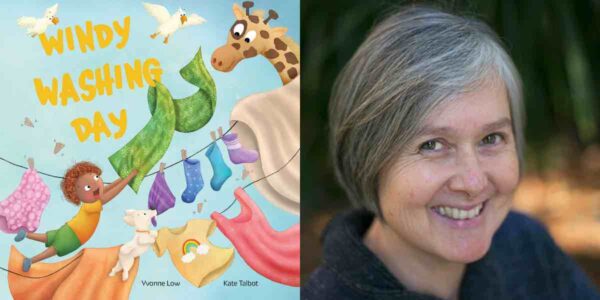
Congratulations on the publication of your newest book – Windy Washing Day. What was the inspiration – other than windy washing days?
A family member used to live near to Taronga Zoo and they could hear the gibbons calling during the day. That started me thinking about what it might be like to live near the Zoo and maybe even right next door! What mundane things you could be doing which might be impacted by that scenario. And so my story came about – an ordinary day which turns extraordinary.
I also love animals and could picture the crazy interactions they might have with wind-blown clothes finding their way into their hands, paws, claws, trunks…
The book has received very positive reviews. Which review pleased you most (or made you shout out, ‘Yes, that is what I was going for!’).
I’m thrilled that we’ve already received such great reviews. When I wrote the book, I’d spent so much time focussing on the wordplay and rhyme and working within that kind of structure, that I’d not fully realised how funny my story is. So, it’s been wonderful hearing, seeing and reading the reactions of readers and reviewers – how they’ve engaged with the cheeky humour, how much fun it is both for reading aloud and as a book to read again and again.
I’m very pleased that they’ve recognised there’s so much to enjoy both in the text and in the beautiful illustrations. With picture books, you’re aiming not just to entertain the youngsters, but also the adults who read it with them.
In your practice, what comes first, the art or the words?
For me, the creation of a story can work both ways. It depends on what the idea or catalyst might be. It could be a word or phrase that jumps out at me and spins me off into wordplay or word association and I’ll focus on developing the text. Or it could be a drawing I’ve made from my imagination or from something I’ve experienced or seen on the street or in nature, which might reveal a character who eventually calls for a story of their own, and I’ll start developing those illustrations further and then work on the text around that.
For example, I once drew a series of character vignettes for a competition, which didn’t result in a win, but did enable me to later develop a whole story around that particular character. In that instance, developing my project for this character led me to be a finalist in the SCBWI Australian Picture Book Illustrator Awards and later win an ASA/CA Mentorship. It has also taken me on a creative journey to work within the completely new genre for me, of graphic novels.
In relation to writing and illustrating my own picture books generally, especially if I’ve started with the words, I’ll go as far as I can with that as a writer. Then it’s helpful to work upon the story as an illustrator, creating a storyboard and maybe some character roughs. Doing those can result in changes to my text and subsequently also my illustrations. It’s a back-and-forth process of refinement.
You are also an illustrator. What do you see the role of an illustrator as and does it differ from you illustrating your own books?
The role of an illustrator is to try and focus on the most significant moments in a story and to avoid just replicating what’s in the text. The best illustrations take the story to another level and add extra layers of meaning and subtleties that can be discovered or are revealed over multiple readings. Encouraging the child to both read the text and to ‘read’ the illustrations. For example, the writing tools of motif and foreshadowing can be used also in illustrations to great effect.
Ideally, an illustrator matched to a text will bring their own great ideas and a fresh way of looking at the text and story as a whole.
When I’m illustrating my own book, because I’ve been living with the story for a long time, and I’ve considered the choice of words carefully in relation to the potential images, I’d hope to bring a natural synergy to the book. Still be open to fresh ideas and working on bringing extra layers of meaning into my story.
As if you don’t have enough skills, you also write poetry. What moves you as a poet and how does that fit within your creative self?
I’ve had a few recent years of upheaval, where access and time for working on my art in particular have been limited, so one aspect of that is I’ve been able to at least create more poetry. For me, it’s another ‘visual’ literary artform, but this time, the images are in my mind’s eye and are linked more directly perhaps to the emotional response to what’s happening around me. It’s been wonderful to just be able to record those thoughts in either a loose or structured way, and poetry can provide the framework for that. It’s allowing a small space for pause, contemplation and reflection – a breathing space.
Short form poetry like tanka is perfect for limited creative time and opportunity and as a result, very satisfying. It’s that emotional response to an experience, often connected to nature, which is then distilled into a 5 line word-picture.
I write poetry for both kids and adults. The stimulus results in either a fun poem for a child, or a more subtle, profound, lingering response more suitable for adult readers. Basically, poetry is (in particular most recently) an emotional and creative release for me and has kept me sane!
You recently did a series of events to launch Windy Washing Day. Many of us are all too familiar with the traditional book launch, how does a book launch for young kids differ? How do you prepare?
With picture books, it’s all about colour and fun and a lively, preferably interactive, whole-book reading and presentation, not too long, with just a short introductory speech. Of course, with a gentle slower-paced picture book like Lola and Grandpa, a story of loss (for which I created the illustrations), there are still opportunities for interaction with what’s happening on the page, but in a quieter way.
For Windy Washing Day which is filled with mischievous zoo animals, I used hand puppets (characters from the book) to engage the audience from the start, and to keep ‘littlies’ focussed, I asked them questions about each page of the book and encouraged them to make animal sounds at appropriate moments.
The environment of the launch needs to be fun as well – bookstores are great places for children’s book launches as they’re generally already set up to attract families and youngsters. My launch was at Bookface, St Ives Village and Manager Luke and his team ensured everything ran professionally and smoothly. Sweet treats on offer add to the celebratory vibe (mine were animal-themed cupcakes, jelly snakes, biscuits), and a raffle give-away copy of the book with a small plush toy book character (or suitably themed take-away gift bag) is a wonderful feel-good way to finish up. Children’s book authors generally have a large vertical book banner which acts as a colourful backdrop for the book reading and book/author promotional tool and works as a focus for photos as well.
Of course, given that there are kids involved, you have to be ready for anything, so be prepared to think laterally and ‘go with the flow’ on the day. And even if there aren’t many kids at your book launch, you can still appeal to the attending adults’ inner child and you’ll find that they’ll be more than happy to participate in your child-targeted presentation. It will all work out in the end!
What is your next project? When might we see it in print?
I have a number of my own manuscripts on the go, some also with initial storyboard ideas, along with my graphic novel/picture book project which is waiting patiently for me to get back to. These are all dependent on finding some favourable publisher attention, at the right time…
In the interim, I have poetry being published shortly in November with Eucalypt: a tanka journal and Poetica Christi Press’ latest anthology ‘Life’s Tapestry’.
Lastly, what are you currently reading?
I’m currently reading a new middle-grade graphic novel ‘Inked’ (Karen Wasson and Jake A. Minton), published by Hardie Grant under their new GN imprint Figment. I recently attended an ASA webinar giving a behind-the-scenes look at the making of this, so it’s great to be able to read it now, especially with some knowledge of how it all came together creatively.
Yvonne Low is a writer, illustrator and award-winning fine artist, creating picture books, poetry and junior fiction. Her work is whimsical and often has a dash of humour and wordplay. She takes inspiration from nature, the performing and visual arts, and through her travels.
Yvonne is published with MidnightSun Publishing, Little Pink Dog Books, Christmas Press, ABC Commercial, The School Magazine, Eucalypt: a tanka journal and Poetica Christi Press. She was a finalist in the 2021 SCBWI Australian Picture Book Illustrator Awards and won an ASA/Copyright Agency Mentorship Award. Yvonne’s debut picture book (as illustrator) was Lola and Grandpa (Little Pink Dog Books, A. Kwok/Y. Low) and Windy Washing Day marks her debut as a picture book author.
Get in touch with Yvonne here, learn about her most recent book, or follow her on X or linkedIn.
Read about past Spotlight On writers here.