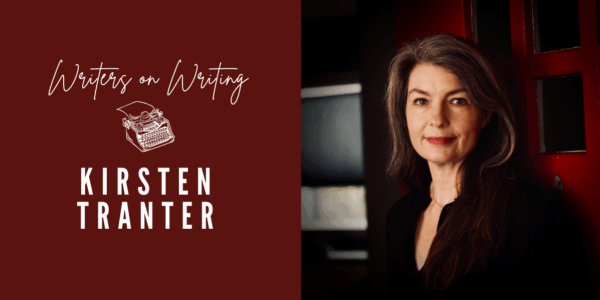
Writers on Writing is our regular conversation with a writer or industry professional about the writing craft, industry insights, and their own practice. This week, we spoke to Kirsten Tranter about generating narrative energy, reading in an intentional way, and learning to unconsciously incorporate elements of craft in writing.
What are the craft essentials you have most struggled with as a writer?
I used to have a lot of insecurity around dialogue for some reason. I felt that I could crack the mysteries of writing a pleasing sentence and I was confident in the stories I created. But with dialogue it was just hard for me to tell when it was working and when it wasn’t.
I also struggled a bit with how to bring tension into my writing and it’s been helpful for me to understand the principle of conflict and how important it is in terms of generating narrative energy. I would have a sense of an exchange between two characters I wanted to write, and just know somehow that it mattered, but not really understand why. I think that coming to understand the principle of conflict has given me the tools to understand more about things like – what is the point of this exchange, or this scene or this moment? What problem is it establishing, working through or resolving? Or what question is being raised? That has helped to sharpen my writing.
What has helped you master your craft?
My initial answer is one word, practice!
In fact I’ve had the good fortune to work with some excellent editors who helped make my writing better. I’ve learned so much from them on many levels including being better able to see my own awkward habits and tics, and how to make a sentence stronger.
I learn from reading in a very conscious and intentional way, paying attention to how other writers use craft. Other writers are simply the best teachers.
Teaching has been an important part of helping me master my craft too. When I teach, I have to clearly articulate the principles of craft, and show how it works in practice, and this has powerful effects on my own sense of how I use craft. I never read anything as carefully as I read the pieces of writing I am preparing to teach with, and this is a great kind of experience in deep close reading. I always see something new and learn something new every time I teach a piece of writing that I love, even if I have taught it ten times before.
How do you balance craft skills with creativity in your writing?
My approach is to let myself be guided as much as possible by instinct and imagination when I’m writing. I do not bring my critical mind to that work. I want it to be as much like daydreaming on the page as possible. I have enough experience now to be able to incorporate a lot of elements of craft unconsciously. And this is really the goal of classes like the one I’m teaching – to demystify those skills, to practice them consciously and intentionally, so that they can more easily become part of the repertoire one can draw on without thinking so much about it while drafting.
The time to think about craft consciously for me is in the process of editing and revising, when there is a first draft to push and pull into shape with deliberate attention to questions of craft.
Who are your favourite masters of plot, character, and dialogue? And why?
I could go on for PAGES – Rachel Cusk, Edward St Aubyn, Edith Wharton, André Alexis, Ian Rankin, Raymond Chandler – but I’ll stop at just two.
Henry James. His plots are masterpieces of simplicity on one level, and yet so ambiguous, so intricate and complex at the same time. His characters just throw themselves off the page with life. And he has the capacity to make a character come to life when they are doing anything, or nothing – as in the famous centerpiece of The Portrait of a Lady, when the protagonist literally spends hours sitting in a chair by the fire, thinking. She has epiphanies, and sees the true horror of the situation she has been manipulated into, and she arises from that chair transformed. It goes against the grain of everything we’re taught about the importance of action, conflict, etcetera. It should be dull and dead on the page. But it smoulders with intensity.
Sally Rooney. I love Sally Rooney’s elegant minimalism, the way she captures awkwardness in dialogue so convincingly, and her incorporation of text messages and emails. I’m a romantic at heart so I adore the ways her stories are essentially love stories. I love the way she explores just how hard it is for people to figure out how to love one another in this broken world, and how quietly magnificent it is when that succeeds. And it doesn’t always look like a traditional happy ending. I love the ending of her novel Conversations with Friends, where her narrator realises that she can love two people at once, and she does, and she’s going to keep living with that truth and try to make that work in the world. The final line sticks with me: “Come and get me.” She’s been in this painful push and pull with this man, and I love that she ends with this expression of desire. Who knows what will happen when he gets there? But she’s asked him. And he will. That’s really all that matters in that moment. And in Normal People, where the most true expression of love for these two people is for her to just let him go. It’s so heartbreaking and yet, even as a romantic, I wouldn’t change it.
Kirsten Tranter is an internationally acclaimed author, editor, and critic based in the San Francisco Bay Area, and co-founder of the Stella Prize for Australian women’s writing. Kirsten is the author of the novels Hold (2016), longlisted for the Miles Franklin Award and the Voss Literary Award, A Common Loss (2012), and The Legacy (2010, named a Kirkus Review debut novel of the year, shortlisted for the ALS Gold Medal and the ABIA literary fiction award, and longlisted for the Miles Franklin award, in addition to short fiction and essays. She has mentored authors and taught creative writing and literary studies around the world at the Faber Academy, the University of California, Berkeley, the University of Copenhagen, the University of Technology, Sydney, and many workshops.
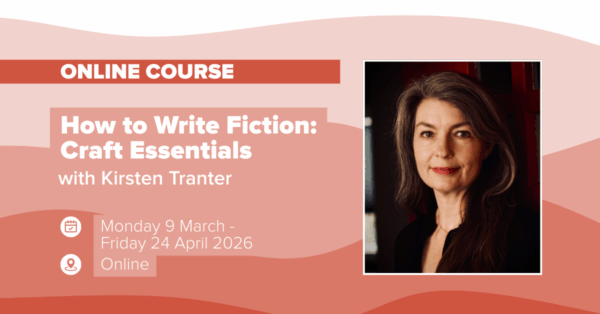
Join Kirsten Tranter for How to Write Fiction: Craft Essentials, Monday 9 March to Friday 24 April 2026, online.
More from Writing NSW
Check out our full range of writing courses in Sydney, our online writing courses and our feedback programs to see how we can help you on your creative writing journey. Find out about our competitions and opportunities, as well as writing groups across NSW, and sign up to our weekly newsletter for writing events, opportunities and giveaways.