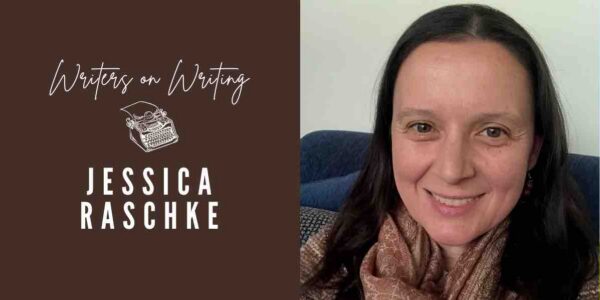
Writers on Writing is our regular conversation with a writer or industry professional about the art of writing, industry insights, and their own practice. This week, we spoke to Jessica Raschke about clarifying and connecting with your emotions through writing, exploring one’s inner self on the page, and how writing is a vehicle for release and introspection.
Why is writing such a powerful vehicle for inner work and self-exploration?
Writing is one of the best ways to transfer the wild rummage of emotions, thoughts and beliefs that circulate in your mind onto the page. In this way, writing helps bring a greater sense of clarity and connection. Emotions, thoughts and beliefs can feel overwhelming when they’re internal. When you write them down, they become objects you can look at, explore and work to understand. They might even appear more beautiful, curious, or meaningful to you. It’s a beautiful outlet for release, a more conscious space where you can question, reframe, and deepen your sense of self-connection and self-understanding.
How can developing insights into one’s inner self improve writing practice?
I firmly believe that reading and writing are powerful pathways towards understanding the intricacies and magic of the human heart and soul. So many forms of writing, such as poetry, memoir, novel, plays, songs, are where other people reveal and share their stories. Where else do we get such intimate access to the ways in which others experience themselves? This principle, of course, applies to writers themselves. In developing our own self-awareness, self-connection, and understanding of what an authentic voice ‘looks’ and ‘sounds’ like on the page, writers can develop more refined judgement and become better skilled at writing.
Is self-exploration through writing only possible when writing first person? Can writing in third person reveal something different in self-exploratory writing?
In a way, it makes sense that writing in first-person is the best way to give expression to yourself. It seems more immediate and transparent, like you’re not trying to hide anything from yourself or your readers. Yet the sense of distance or detachment that comes from writing in third person can be enormously liberating, and possibly a lot more fun. It can offer permission to write content that feels too risky or uncomfortable, yet still emotionally authentic, and to take your writing into previously unexplored territory.
What is the difference between the practice of self-exploratory writing and automatic writing?
Self-exploratory writing usually stems from an intention to find something within yourself: in a way, you know something is there and you’re seeking to give expression to it. It can be a lot more self-conscious, with writers inclined to be a lot more reflective and keen to generate clear meaning in their approach. Automatic writing is rooted in traditions like dadaism and surrealism, which means it loves what is unknown, what lies deeper within the unconscious, so it’s interested in discovering what you didn’t know was there. Automatic writing is a lot of fun. It can be daunting and frightening, but it can also be the deliverer of some wild and worthwhile insights.
Jessica Raschke is a writer, poet, artist, and therapist based in the Southern Highlands. She has had three poetry collections published by Ginninderra Press—Luscious Glass Cage, The Beguilings, and Lightning Shades—while her most recent art installations were featured at Articulate Project Space and Way Out (Kandos). Jessica has a BA from University of Melbourne and a PhD in Culture and Communication from RMIT University, where she also studied Professional Writing and Editing. She now works as a Lecturer in Holistic Counselling and Psychotherapy at the Metavision Institute. All of Jessica’s work is guided by existential and soul-informed explorations into what makes for a meaningful existence—and since training with the Natural Death Care Centre and Preparing the Way, she has also worked as a death literacy advocate and facilitated a range of Death Cafes and Mortality and Mystery gatherings throughout New South Wales.
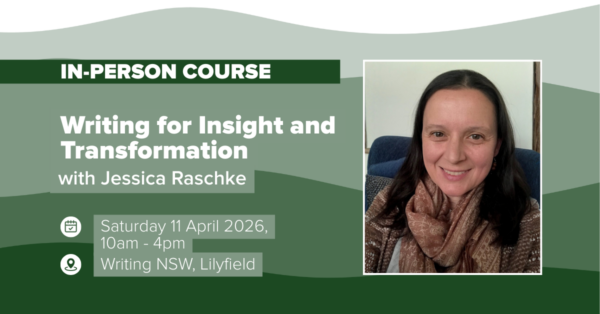
Join Jessica Raschke for Writing for Insight and Transformation, Saturday 11 April 2026, 10am-4pm at Writing NSW, Lilyfield.
More from Writing NSW
Check out our full range of writing courses in Sydney, our online writing courses and our feedback programs to see how we can help you on your creative writing journey. Find out about our competitions and opportunities, as well as writing groups across NSW, and sign up to our weekly newsletter for writing events, opportunities and giveaways.