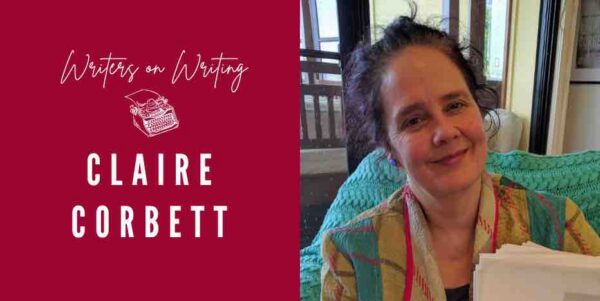
Writers on Writing is our regular conversation with a writer or industry professional about the writing craft, industry insights, and their own practice. This week, we spoke to Claire Corbett about what makes a short story stand out in today’s publishing landscape, how to make space for the right amount of detail, and how short stories have changed over the last few decades.
What is the role of the short story in Australia’s publishing landscape?
The short story is a laboratory and the cutting edge. It’s the mainstay of contemporary fiction in literary journals and a form where readers, writers, publishers and agents can keep an eye on emerging writers and also on what writers at any stage are doing.
Novels can take years, even decades to write. Short stories can take a long time too but they can also respond to the world in a more immediate way and can experiment with style and technique.
It’s the most surprising and delightful form and I would love for more people to discover how exhilarating reading short stories can be. The best ones repay endless rereading, especially if you want to know how literary techniques work and some stick in your mind in a way many novels do not.
As the fiction editor at Overland, you must see countless short stories. What makes a short story stand out?
Depth of insight. Awareness of form. Playfulness. Humour and sometimes anger. Strong imagery. Confidence in handling time, voice and point of view. Understanding of what makes a good short story now, not fifty years ago.
How has the short story changed over the last few decades?
One of the biggest changes is the move away from straight realism or naturalism. There is much more experimentation with style and form.
A huge change is that stories are much tighter now; they don’t include long passages of repetitive dialogue just because that is true to the way people speak.
Short stories have to provide surprising and different experiences for the reader. And of course the subject matter changes – stories of climate change and environmental collapse are common now – as they should be. The challenge of this is in finding what the short story form can bring to such themes that nonfiction does not. On the whole, short fiction is leaner but more immersive, richer in sense detail, now than the older works I’m reading, which can be quite dry. Maybe this has something to do with the increase in creative writing courses.
Why is structure especially important for short story?
Because there’s no room for flabbiness. The short story generally has to start much later in the story arc than the novel. There’s only space for just the right amount of detail.
What is your advice for writers who keep submitting to literary journals, but can’t seem to get published?
It’s hard to get published – there’s enormous pressure on literary journals in Australia and things have gotten much worse in the last couple of years. The lack of funding and support for writers in Australia is shocking and shameful. Now is the time for you to subscribe to literary journals if you want them to survive long enough to publish you,
The most important thing is to read a lot of short stories, especially contemporary ones, especially stories published in the journal that you would like to be published in. The most common mistake, by far, is not reading enough contemporary short fiction. It’s glaringly obvious to me, as fiction editor, if you don’t read contemporary short stories and you don’t read Overland when you submit your work. Many writers I publish love and respect what Overland does and it shows in their work; they are very aware of what Overland is looking for – which is very broad, I hasten to add, but does have some consistent features. If you don’t read much contemporary short fiction, your work will likely have a kind of stale air to it; it will draw on work that was popular decades ago. I see a lot of stories like that.
Here are some beautiful and thought-provoking stories Overland has published in the last few years to give readers an idea of what I mean:
- Breathing Lessons by Laurie Steed
- Espalier by Kerry Greer
- Australians at Work by Alex Cothren
- Using the Method by Brad Gilbert
Dr Claire Corbett is a writer of novels, short fiction and creative nonfiction. She lectures in Creative Writing at the University of Technology, Sydney, where she has taught the short fiction subject to MA students for a number of years. She is the fiction editor of Overland Literary Journal.
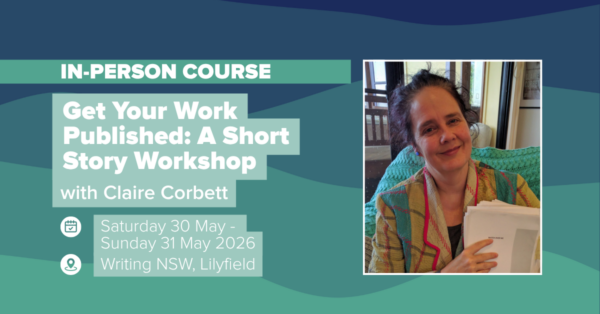
Join Claire’s course, Get Your Work Published: A Short Story Workshop with Claire Corbett, Saturday 30 & Sunday 31 May 2026, 10am-4pm at Writing NSW, Lilyfield.
If you want to be the first to read great advice, prompts and inspiration from our incredible tutors, subscribe to our weekly e-newsletter Newsbite.
More from Writing NSW
Check out our full range of writing courses in Sydney, our online writing courses and our feedback programs to see how we can help you on your creative writing journey. Find out about our competitions and opportunities, as well as writing groups across NSW, and sign up to our weekly newsletter for writing events, opportunities and giveaways.