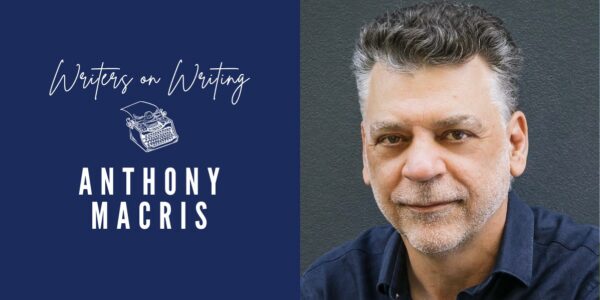
Writers on Writing is our regular conversation with a writer or industry professional about the writing craft, industry insights, and their own practice. This week, we spoke to Anthony Macris about how writing style is responsive to perspective, why thinking about narrative voice matters, and how to become more conscious of language decisions.
What is style, and why does it matter?
Style is one of the key ways writers shape a reader’s experience. But language can be an unwieldy beast, and knowing the fundamentals of how prose is constructed is the first step to controlling it. The most obvious entry point to style is understanding the types of words and sentences you decide to use in your prose. These decisions will have a big impact on the world you want to create for the reader, as well as the kind of reading experience you want to give them.
What I hope people get out of my workshop is a greater awareness of choice and control, which can really help to produce accomplished prose. For example, do you want your language to be like Orwell’s clear windowpane, something that tries to make itself invisible so that the story and characters come fully to the fore? Or do you want to provide a reading experience that is more ornate and lyrical, where the language draws attention to itself as well as to the elements of the story?
There’s a similar decision to be made around sentences. Your prose can tend towards short, declarative sentences that use the minimum of connectives. Or you can go for sentences of varying degrees of complexity. What I’ve mapped out here are simply tendencies at the ends of a spectrum: all kinds of combinations are possible.
At what point in your writing journey did you start thinking about narrative voice?
Voice is an interesting concept. It’s inseparable from style, but it does need to be differentiated somewhat. I call it the personality that is projected by the narrator through the writer’s choice of style.
As a writer, I’m very conscious of it, and I like to try different things. As a novelist, I try to keep the prose measured and balanced, but full of surprises, some more obvious than others. As a writer of creative non-fiction, I tend to write in a confessional mode, which aims for a kind of lyrical restraint.
What is the relationship between the style and the narrator? How does it vary across fiction and non-fiction?
This is a fantastic question. The relationship between style and the narrator is central to good writing. In fiction especially, style needs to be responsive to perspective. When you create a major character, you also need to think about how they see the world and what kind of language belongs to them.
This is often easier in first person, where the prose can be shaped more directly by the character’s own speech and thought. It becomes more complex in third person, because the narrator is speaking on the character’s behalf. Even so, the style still needs to feel flexible enough to accommodate the character’s outlook and sensibility.
In non-fiction, the relationship is a little different, because the narrator is usually closer to the writer’s own speaking self. But style still matters enormously. It determines how experience is framed and how a reader connects with the voice on the page.
Is style always intentional?
It can be intuitive or intentional. Where it’s intuitive, it’s probably because the writer is unconsciously using a style based on what they like to read, and that’s fine: that’s how most writers start out. We’re inspired by what we love.
But the intuitive approach will only get you so far. At some point you will need to consciously think about style, and this is what my course, Creating Voice: Crafting Style in Fiction and Creative Non-Fiction, aims to help you do. For example, how do you use poetic devices, such as metaphor, simile and alliteration, in prose? We all know them because they’re a standard feature of literary prose, but they need to be approached with care, or you can end up with a style that doesn’t serve your purpose.
How is sentence structure important to style?
At the practical level, the sentence is probably the single most important vehicle for style. The type of sentences you write are critical for readability, flow, and keeping the reader engaged. The types of sentences we find in prose change according to genre, and according to historical period as well.
I’m reading Thomas Hardy at the moment, a novel called Jude the Obscure, and it’s full of the kind of complex, ornate sentences common in the late 19th century. I’m also reading Happening by the contemporary French writer Annie Ernaux. It’s a memoir written in simple, diamond-cut sentences. Different genres, different times.
The bottom line for me is that sentences are there so you can communicate with others. They’re like little streams into which you pour your vision of the world, so that it can be shared with others. They’re meaningless without that impulse.
Anthony Macris is Adjunct Professor of Creative Writing at the University of Technology Sydney and one of Australia’s leading writing teachers. He is author of the Capital novels and Inexperience & Other Stories. His best-selling memoir, When Horse Became Saw: A family’s journey through autism, was shortlisted for the 2012 Prime Minister’s Literary Awards. His essays, reviews and poetry have appeared in Manchester Review (UK), Antipodes (US), Meanjin, Griffith Review, and Sydney Review of Books. His most recent book is Aftershocks: Selected writings and interviews. “One of the most interesting writers of our time.” – Sydney Morning Herald/The Age.
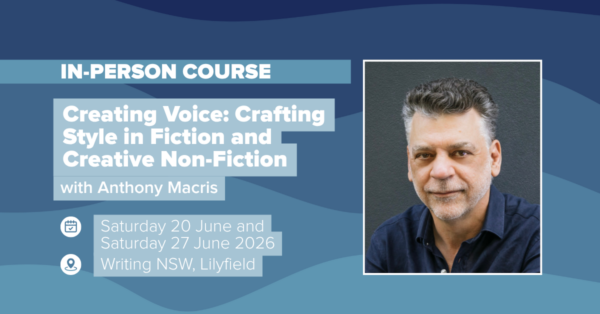
Join Anthony’s course, Creating Voice: Crafting Style in Fiction and Creative Non-Fiction, Saturday 20 & Saturday 27 June 2026, 10am-4pm at Writing NSW, Lilyfield.
If you want to be the first to read great advice, prompts and inspiration from our incredible tutors, subscribe to our weekly e-newsletter Newsbite.
More from Writing NSW
Check out our full range of writing courses in Sydney, our online writing courses and our feedback programs to see how we can help you on your creative writing journey. Find out about our competitions and opportunities, as well as writing groups across NSW, and sign up to our weekly newsletter for writing events, opportunities and giveaways.