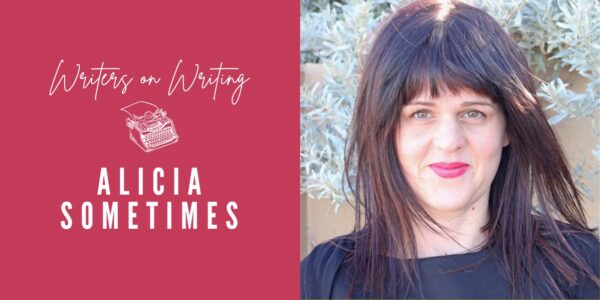
Writers on Writing is our regular conversation with a writer or industry professional about the writing craft, industry insights, and their own practice. This week, we spoke to Alicia Sometimes about the process of curating a poetry collection and finding a home for your poetry. We also discussed the pairing of sound, music, and words in recorded poetry and what inspires her as a writer and reader of poetry.
What inspires you as a poet?
The most inspiring thing to me as a writer is the same thing that excites most writers—new ideas, patterns, collaborations, strange combinations, essential dialogue, authenticity. These are also the elements that ignite me as a reader too.
What is your process for curating a poetry book? For your most recent collection, Stellar Atmospheres, did you start with a structure in mind, or did it emerge as you wrote?
I’ve been lucky enough to see many collections being born up close. Some people know the structure right away, some tinker with ideas, some abandon long held ideas and start over again. I am always painfully slow. So I started one way, went through at least twenty ideas and then settled on what felt the most considered at the end. I had about ten people I trusted reading the collection and all of them had a completely different idea of structure (and also what poems should be in or left out). Instead of being confusing, this was so helpful. I find the getting the structure together the most fun to do.
What is the most valuable feedback you’ve received on your poetry?
Better to have a poem you love knocked back than have one you sort of like accepted in a journal. This may sound obvious but sometimes, especially early on in your writing career, you might take any publishing opportunity as a win. I think it’s important to write for yourself, sit on your work for a while, edit and edit again and then send out in the world. If you love it and you’ve crafted it carefully, it mostly finds a beautiful home.
As the editor of Going Down Swinging for seven years, how you seen Australia’s poetry landscape changing – particularly in the digital publishing sphere?
One of the main reasons I took on the challenge of editing Going Down Swinging back in the 2000s was the idea that there would be a physical copy of audio recordings to accompany the printed work. I have always loved the spoken word and am completely passionate about sound, music and words being paired together. I think they make a stunning marriage. It’s not that digital downloads weren’t a huge part of every day life back then, I just loved having physical copy of a CD to keep and cherish. It was also a way of getting played on the radio as it was a lot less easy to discard than an email link. But physical CDs aside, a big part of why I wanted to be editor was to make sure this art form had a prominent place in Australia’s recorded history.
One main change has been that artists are free to put out their own work on their own platform without waiting for permission or acceptance. So the audio, video, printed work still lives on in a vibrant way, so the editor needs to capture this reality in unique ways. I’ve seen links, QR codes, embedding multimedia in so many interesting ways. There’s no fear these poetic pieces will cease to be recorded.
One thing that hasn’t changed is there’s still challenging, thrilling, emotive and fascinating work being made. I’m always astounded at the quality that persists. This is why the Australian literary scene is still an energetic and wonderful place to be. I keep reading, listening and watching the very best Australia has to offer.
While editing poetry, how do you balance sensitivity with actionable feedback for improvement?
The main thing to consider is that firstly, editors make suggestions. Sometimes non-negotiable ones but they are just suggestions so you have the ultimate say. The other thing is that editors are mostly your champions, they want to see you win and would love you to come out with your best work. As an editor, I always find the process a dialogue not a monologue. And as a writer, I’ve found the best questions and observations have come from editors who sometimes find another doorway or key that you didn’t know existed.
Alicia Sometimes is a poet, artist and broadcaster. She has performed her poetry at many venues, festivals and events around the world. Her poems have been in Best Australian Science Writing, Best Australian Poems and many more. Alicia is director/co-writer of art/science planetarium shows, Elemental and Particle/Wave. Alicia has been awarded residencies at KSP Writers’ Centre, Varuna, Melbourne Aquarium, Boyd Garret and a virtual residency for the Manchester City of Literature and Manchester Literature Festival. In 2023 she received ANAT’s Synapse Artist Residency and co-created an art installation for Science Gallery Melbourne’s exhibition, Dark Matters. Alicia teaches writing and radio production in Sports Media, Screen and Media at Swinburne University. Her latest book is Stellar Atmospheres.
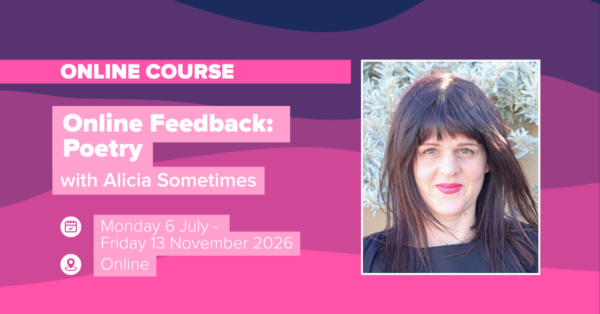
Join Alicia Sometimes’ course, Online Feedback: Poetry with Alicia Sometimes, Monday 6 July to Friday 13 November 2026 (5 months), online.
If you want to be the first to read great advice, prompts and inspiration from our incredible tutors, subscribe to our weekly e-newsletter Newsbite.
More from Writing NSW
Check out our full range of writing courses in Sydney, our online writing courses and our feedback programs to see how we can help you on your creative writing journey. Find out about our competitions and opportunities, as well as writing groups across NSW, and sign up to our weekly newsletter for writing events, opportunities and giveaways.