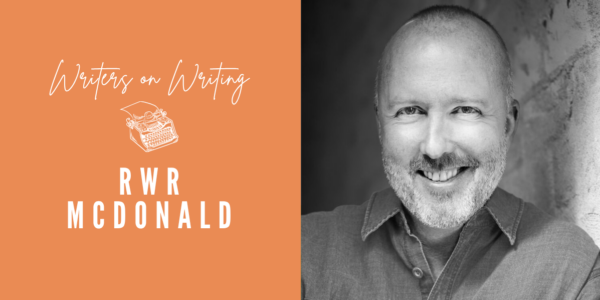
Writers on Writing is our regular conversation with a writer or industry professional about the writing craft, industry insights, and their own practice. This week, we spoke to RWR McDonald about how stories unfold from well-written characters, the dangers of writing with a passive voice, and what being a writer means to him.
When you start writing, do you begin with character or plot?
Great question, and not giving a politician answer but both, sometimes? It may start off with a character which leads me to question who they are. But usually, it is accompanied by a thought of either what they are thinking, or what they are doing, or where they are. It is from that information that I start to follow them. So maybe it is character with a scent of plot? One of things I love about writing crime fiction is you have this wonderful narrative device built into any plot – whodunnit, or why did they do it, so maybe that’s my short cut in!
What are some signs that a writer’s plot is happening to their characters, rather than being driven by them?
This happens if a character is being passive and not taking action. I unsuccessfully tried writing from the POV of a character observing, but not actively taking part in, a murder investigation. It read flat on the page – now a great writer could perhaps make that compelling, but I think where I had gone wrong was the passivity. As soon as I dropped that, gave my character stakes in the plot, the story came alive. If your character is having things happen to them all the time, and other characters are telling them what to do, and they are just following those instructions, there is no conflict, your character may not as well exist, use an inanimate object such as a broom instead. It might make it more interesting.
Did writing dialogue always come naturally to you? What was your journey to writing realistic and compelling dialogue?
The short answer is yes. I feel very lucky that way, I have my own challenges in other areas of writing, but dialogue is not one of them. I love language. I grew up watching far too much TV, reading a lot of books. I love banter, the unexpected, the unanswered in conversations. It is such a great revealer of character. Of relationships between people. Dialogue is about what is said, what isn’t, the pauses and the subtext. It is my absolute favourite!
Show don’t tell, is one of the best-known rules of writing. Is it always true? What’s your relationship to this advice?
It is good advice, but like any advice it is how you apply it. You don’t have to describe a door every time for a character to open it. In fact, especially in first person point of view it can be an anchor for some writers as they think they need to describe every movement, every micro-action. If it can be written simply and with a few beautiful details then who doesn’t want to read that?
When did you first call yourself a writer? What does being a writer mean to you?
I loved writing as soon as I learnt how and realised I could make up stories and fiction was not called lies. BUT it took me until 2016, and Faber Academy, being around other writers that I finally could call myself a writer. I don’t wish that on anyone but yet I hear it from emerging writers all the time who feel strange, or unworthy about calling themselves a writer. I get it, I have lived it, but please, please call yourself a writer. You don’t need anyone’s permission. If you write, and you love it, it is your passion, your calling, you only do it for yourself, you are a writer. Don’t waste another minute not claiming this important part of who you are. It is in your bones; it is in your subconscious. It is you.
R.W.R. McDonald (Rob) is an award-winning author of two novels. His debut novel, The Nancys, won Best First Novel in the 2020 Ngaio Marsh Awards, as well as being a finalist in the Best Novel category. It was also shortlisted for Best First Novel in the 2020 Ned Kelly Awards, and Highly Commended for an Unpublished Manuscript in the 2017 Victorian Premier’s Literary Awards. Nancy Business, his second novel, was a finalist for Best Novel in the 2022 Ngaio Marsh Awards.
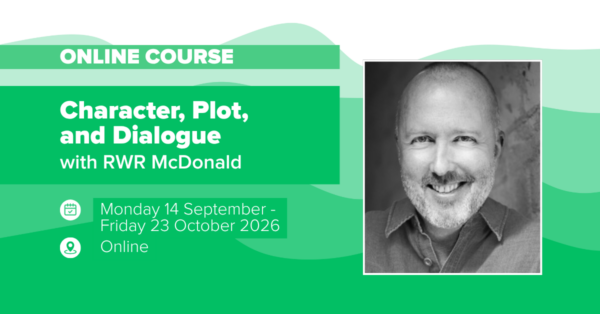
Join Online: Character, Plot and Dialogue with RWR McDonald, Monday 14 September to Friday 23 October 2026 (6 weeks), online.
If you want to be the first to read great advice, prompts and inspiration from our incredible tutors, subscribe to our weekly e-newsletter Newsbite.
More from Writing NSW
Check out our full range of writing courses in Sydney, our online writing courses and our feedback programs to see how we can help you on your creative writing journey. Find out about our competitions and opportunities, as well as writing groups across NSW, and sign up to our weekly newsletter for writing events, opportunities and giveaways.