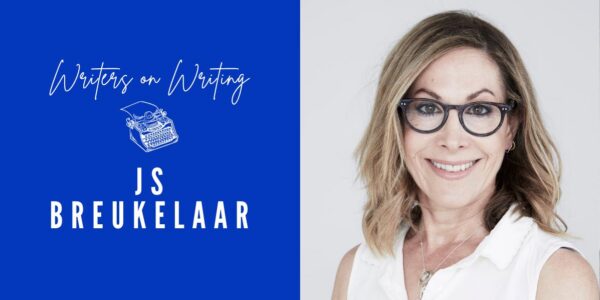
Writers on Writing is our regular conversation with a writer or industry professional about the writing craft, industry insights, and their own practice. This week, we spoke to JS Breukelaar about how the changes unfolding around us can be harnessed in the crafting of speculative worlds and how certain tools can be used to cultivate the ‘fiction of possibility’.
What drew you to writing speculative fiction?
I always loved reading stories that were inexplicable, or imaginative, or dark, or which speculated on worlds, beings, or technology, that could possibly, but didn’t exist. I’ve always loved folklore, and fairy tales, the possibility of dragons, of witches, of ghosts. So when I started writing at a very young age, these were the stories that I was naturally drawn to write—the fiction of possibility.
The speculative fiction genre seems to be constantly evolving, especially since the rise of BookTok. What about these changes excites (or worries) you?
It’s so interesting what you say about BookTok. I’m all for it if it promotes a better understanding and increases the readership of fiction outside the mainstream. Speculative literature, like realism, or crime writing, or any genre, needs to keep evolving to keep up with technological change, cultural change, folklore and regional beliefs, new voices. SF, like all literature, doesn’t exist in a vacuum, and writers in 2026 are going to incorporate the music we listen to, the technology we use, the films we watch, the global affairs that concern us, into the stories we write, just as writers in 1926 did—which, along with stylistic experimentation, keeps the genre alive. Change is good!
Worldbuilding for speculative fiction seems incredibly daunting. How do you approach the process of mapping out new worlds and cultures?
To be honest, the idea that worldbuilding in speculative fiction is more daunting than in any other fiction, is somewhat of an exaggeration. In any story, you need to work very hard to create the world of the story on the page, whether that world is “real” – in which case you need to research and verify and explore, and then subjectify it—or imaginary. In the latter case, you need historical and geographical consistency, believability in terms of the rules of that world and the cultures and characters who occupy it, whether human or other. The most daunting aspect of creating imaginary worlds is to leave room for doubt, for unknowability, for change, for vulnerability, which makes many obsessive worldbuilders uneasy! I prefer to think of it as worldfinding, or simply setting. Because mapping out a real-world setting, whether it’s your own neighbourhood, or city, can be daunting too—the characters who move through that world are not you, and they find and lose themselves in it through their own subjective lenses, which you have to build from the ground up on the page. It’s all daunting!
What kind of thinking does the skilful incorporation of magic, the supernatural, or futuristic technologies in speculative fiction involve?
To my thinking, writing the supernatural, the magical, the futuristic requires a slight shift in vocabulary. The language of this thought, which Ursula K LeGuin calls the “language of the night,” can be a useful tool for all writers—the controlled lexicon of the unconscious, of dreams and nightmare, of poetry and song, of fear, of love. Writers of speculative fiction either come to the craft with an innate knowledge of the language, or show a willingness to learn it—from reading widely for a start, and then thinking about the story they want to tell from the inside out, rather than vice versa. As I say, this way of thinking is useful for any writing, including that of speculative fiction.
JS Breukelaar is the award-winning author of three novels and two collections including The Bridge and Collision: Stories. She is winner or finalist for the Shirley Jackson, Aurealis Awards and Ditmar Awards, and has had numerous stories in acclaimed anthologies and several Years Bests. Her fourth novel, Remedy was listed on the New York Times Best Horror Novels of 2024. One of the featured writers in the Bloomsbury Book of Women in Speculative Fiction, she lives in Sydney with her two and four-legged family, where she teaches creative writing at UNSW.
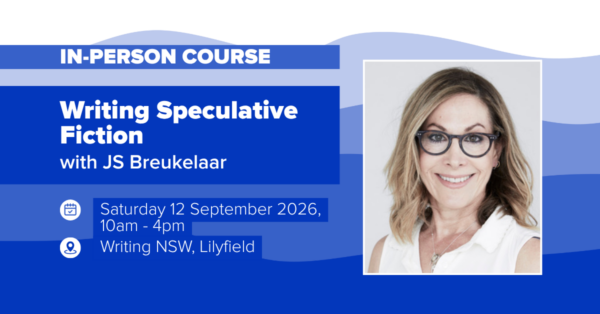
Join JS Breukelaar for Writing Speculative Fiction, Saturday 12 September 2026, 10am-4pm at Writing NSW.
If you want to be the first to read great advice, prompts and inspiration from our incredible tutors, subscribe to our weekly e-newsletter Newsbite.
More from Writing NSW
Check out our full range of writing courses in Sydney, our online writing courses and our feedback programs to see how we can help you on your creative writing journey. Find out about our grants and prizes, as well as writing groups across NSW, and sign up to our weekly newsletter for writing events, opportunities and giveaways.