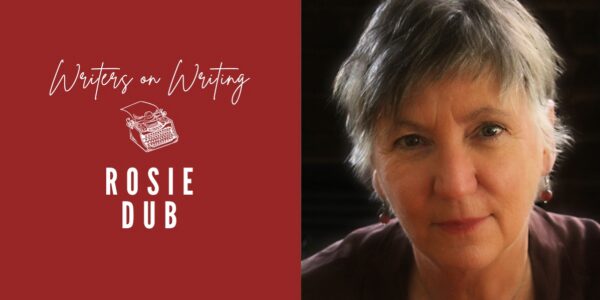
Writers on Writing is our regular conversation with a writer or industry professional about the writing craft, industry insights, and their own practice. This week, we spoke to Rosie Dub about digging into the symbolism of dreams, how she incorporates dreams into her own writing, and ways of framing dreams.
What makes dreams, symbols, metaphors and motifs a valuable addition to our stories?
These days most of us tend to sigh and switch off when someone shares a dream because unless we dig deeper into the symbols the dreams carry, they can seem meaningless. There’s also a lot of advice out there for writers about the wisdom of avoiding incorporating dreams into our stories but this is because it’s difficult to use them effectively in our writing. Yet writers have always used dreams (as Daphne Du Maurier did in Rebecca) or even visions (as Dante did in his Divine Comedy).
Traditionally dreams have always been valued for their inner meanings, in the form of the symbols they contain. Dreams have multiple functions and the symbols they carry have multiple meanings, so there are many ways we can use them in story – as inspiration, as a setting, to adding depth to our characters, to build tension . . . It’s simply a matter of learning some techniques and opening our imaginations up to all the possibilities inherent within dreams and their symbols.
How have you used dreams and symbolism in your own writing?
I don’t set out with the intention of incorporating dreams into my novels yet they seem to creep in of their own accord, and serve a range of different functions, depending on the needs of a particular project. They might be in the form of an omen or prophecy, or provide a solution to a problem, or illustrate a disconnect between the character’s conscious awareness and unconscious motivations.
Sometime recurring dreams form a plot thread in their own right, as is in Between Worlds, where the protagonist has a recurring dream that gradually reveals a little more of itself and links to events in the physical world.
In Gathering Storm, the protagonist has recurring nightmares which are a message from her unconscious hinting at something traumatic buried deep inside her that needs to be looked at. The dreams create tension through foreshadowing, in the form of hints of what’s to come in the story, but they also backshadow, in that they emerge from the past but link with events in the present.
In my novel, Flight, the protagonist has a series of dreams which comfort her, give her strength and guide her forward, while also containing a number of symbols that are then referenced here and there in the story, creating a symbolic thread that adds depth to the story and enriches its themes.
And in Rosebud, a memoir/narrative non-fiction I’ve recently completed, there’s a slippage between dream and physical reality that increases as the story unfolds. I used a dream I had many years ago and adjusted it a little for the story. Then it took off and expanded as the dreamscape itself and the character of Rosebud (myself as a child), became another aspect of the story’s setting.
What are some examples of books that incorporate dreams?
There are so many wonderful examples. But here are three that come to mind, each using a different technique and each framing the dream differently.
Alice in Wonderland is a famous example and a fabulous one. A story structured around a dream. A girl falls asleep under a tree and finds herself following a white rabbit down a rabbit hole and into Wonderland. What happens next has a dream-like quality, where the impossible becomes possible and logic is overthrown by the absurd.
In Kafka’s Cat, Haruki Murakami effectively incorporates dreams into the story and as with all his writing, creates a magical realist sense of slippage between the physical world and the dream world.
Sometimes dreams serve as inspiration for an entire novel, as was the case with Mary Shelley’s Frankenstein which emerged from a dream. She didn’t dream the whole story but there was enough there for her to begin to build something – a theme, a character, settings – and the dream itself was powerful enough for her to feel she had to step up, grasp the idea and go with it.
Dr Rosie Dub is a novelist, Flight, Between Worlds, and Gathering Storm which is currently being developed as a feature film. Rosie’s short fiction and creative non-fiction articles are published internationally. Her writing, teaching and mentoring are deeply rooted in the role story plays as a vehicle for individual and cultural transformation. This was the subject of her PhD, and her Alchemy of Story newsletter on Substack continues this journey into the heart of story.
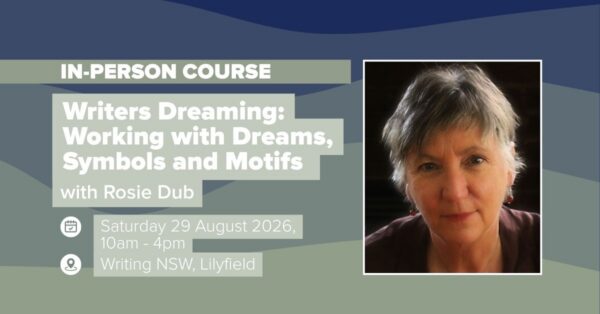
Join Writers Dreaming: Working with Dreams, Symbols and Motifs with Rosie Dub, Saturday 29 August 2026, 10am-4pm at Writing NSW, Lilyfield.
If you want to be the first to read great advice, prompts and inspiration from our incredible tutors, subscribe to our weekly e-newsletter Newsbite.
More from Writing NSW
Check out our full range of writing courses in Sydney, our online writing courses and our feedback programs to see how we can help you on your creative writing journey. Find out about our competitions and opportunities, as well as writing groups across NSW, and sign up to our weekly newsletter for writing events, opportunities and giveaways.