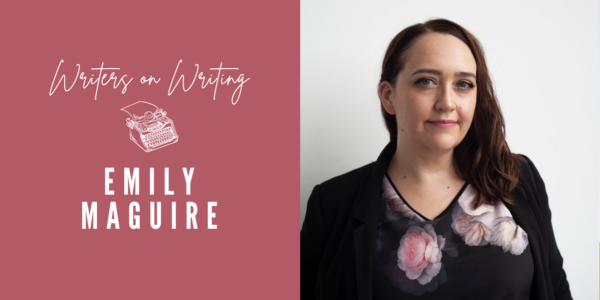
Writers on Writing is our regular conversation with a writer or industry professional about the art of writing, industry insights, and their own practice. This week, we spoke to Emily Maguire about how craft is much more than a set of rules, following your curiosity and emotion while drafting, and the most valuable writing lessons she’s learned.
How conscious are you of craft considerations while writing? Do the technical elements of fiction hinder your creativity?
I try not to think too consciously about craft in the early stages of a novel. My job in the beginning is to follow my curiosity and emotion and discover what the story might be. Once I have a draft down, thinking deliberately about things like point of view, voice, rhythm of sentences, scene shape etc becomes very important. Far from hindering creativity, a strong grasp of craft liberates it by allowing me to turn raw material into something coherent and powerful.
How has your relationship with craft changed throughout your journey as a writer?
When I began writing novels, I thought craft meant learning rules. Over time I realised it’s less about rules and more about awareness and choice. Becoming confident in my craft means that I don’t need to stress about my early drafts because I know that it’s in redrafting and revision — let’s try this technique, now this, now this — that the really good stuff happens.
What do most emotionally resonant characters have in common?
It’s hard to generalise on this one, because the range of compelling characters in fiction is gloriously large. Having said that, I think readers tend to connect with characters who feel fully human rather than idealised. Often the most memorable characters are those who have full inner lives, and who are flawed and conflicted and capable of being surprising, not only to the reader but to themselves.
Does plotting just involve mapping out sequences of events, or is there more to it?
Plot is really about meaningful change. Events matter only insofar as they affect the characters: forcing them to confront something about themselves or the world. So it’s as much about character and theme as it is about what happens and when.
What have you learned from other writers in their considerations of craft?
That writing well requires attention—to language, to people, to the world around you. Good fiction grows out of deep attentiveness.
Other than that, the most valuable lesson I’ve learned from other writers is that there is no ‘best way’, no ‘one true path’. The best thing you can do is pay attention how other writers create the effects they do, and then practice using those techniques to figure out what works for your story. And at the same time, work on understanding your own relationship to writing — what gives you energy and inspiration, what is the best way of working for you? The best approach to writing is the one that is best for you, at this time, for this project.
Emily Maguire is the author of seven novels and three non-fiction books, and an experienced teacher and mentor of emerging writers. Her novels have been translated into 12 languages and her articles, essays and reviews have been published widely. Emily was the 2018/2019 Writer-in-Residence at the Charles Perkins Centre at the University of Sydney and the 2023 HC Coombs Creative Arts Fellow at the Australian National University. Her latest book is the novel Rapture.
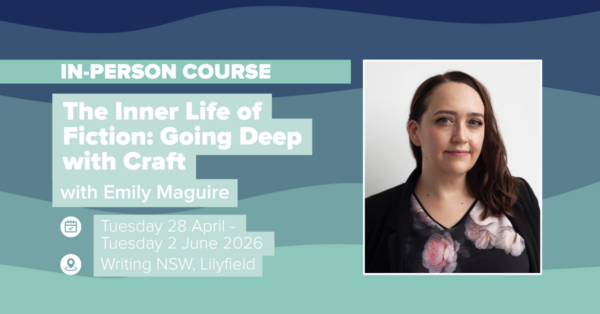
Join Emily Maguire for The Inner Life of Fiction: Going Deep with Craft, 6x Tuesdays: 28 April; 5, 12, 19, 26 May; 2 June (6:30pm-9:30pm).
More from Writing NSW
Check out our full range of writing courses in Sydney, our online writing courses and our feedback programs to see how we can help you on your creative writing journey. Find out about our competitions and opportunities, as well as writing groups across NSW, and sign up to our weekly newsletter for writing events, opportunities and giveaways.