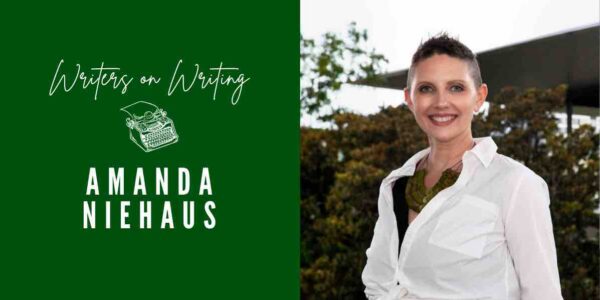
Writers on Writing is our regular conversation with a writer or industry professional about the writing craft, industry insights, and their own practice. This week, we spoke to Amanda Niehaus about intersections within science and writing, and how climate fiction is embedded deeper within our storytelling process than most realise.
Is climate fiction primarily a cautionary tale about the dangers of climate change, or does it have other purposes?
In general, I don’t love cautionary tales. I prefer when writers leave grey space for me (as a reader) to come to my own conclusions. I think great climate fiction does what all great fiction does – it speaks to the very-human emotions that connect us all – love, fear, hope, guilt, loneliness, and so on. We mirror these emotions as we read them, question our own responses to fictional situations and learn what might be possible. Climate change is happening now, to all of us, so a book doesn’t need to be set in the middle of a fire or cyclone to be climate fiction. It doesn’t even need to call itself “climate fiction” – just be about being human and show, in some small way, how an individual’s world is changing.
You’re both a scientist and an award-winning author. Why can fiction be so evocative for understanding difficult scientific concepts or ideas?
I think Rebecca Solnit says it best in her book A Field Guide to Getting Lost:
“[Scientists] transform the unknown into the known, haul it in like fishermen; artists get you out into that dark sea.’’
How can a writer with little scientific background become more confident weaving scientific ideas about climate or nature into their writing?
Science and writing actually have a lot in common – most importantly, I think, that they’re driven by curiosity and, on a more practical level, the continual revision of ideas! I think what’s challenging in this particular moment is understanding what information to trust online – that’s where it’s invaluable to have someone in the scientific community that you can talk to when you get stuck or when you want to verify details. Most scientists love to talk about their expertise, whether it’s what they research or teach. I also watch talks by scientists online, read their memoirs and watch documentaries that give me a sense of what it’s like to be in whatever space I’m trying to write. How being in that space differs depending on who I am or what my immediate circumstances are. Our job as creative writers isn’t necessarily to capture 50 years of research in a ‘teaching moment’, but to evoke the senses of place and perspective and to ask questions. The little details can be the most important!
Amanda Niehaus is Editor-in-Chief of the magazine Science Write Now, which publishes creative writing inspired by science. Her own work has been published in Overland, Griffith Review, Creative Nonfiction, Best Australian Essays, Best Australian Science Writing and more; she won the 2017 VU Short Story Prize and was runner up for the 2024 Bragg Prize for Science Writing. Her first novel, The Breeding Season, was published in 2019.
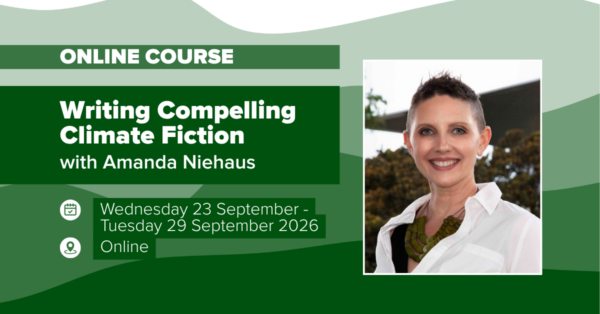
Join Amanda Niehaus for Online: Writing Compelling Climate Fiction, Wednesday 23 September to Tuesday 29 September, online.
If you want to be the first to read great advice, prompts and inspiration from our incredible tutors, subscribe to our weekly e-newsletter Newsbite.
More from Writing NSW
Check out our full range of writing courses in Sydney, our online writing courses and our feedback programs to see how we can help you on your creative writing journey. Find out about our grants and prizes, as well as writing groups across NSW, and sign up to our weekly newsletter for writing events, opportunities and giveaways.