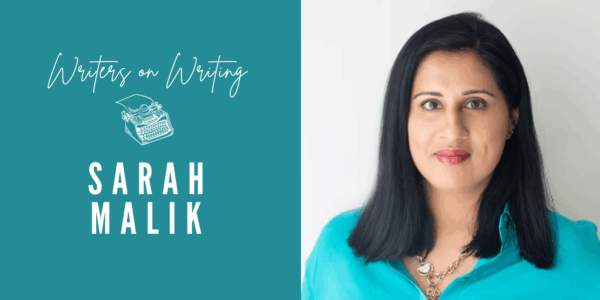
Writers on Writing is our regular conversation with a writer or industry professional about the writing craft, industry insights, and their own practice. This week, we spoke to Sarah Malik about voice and honesty in excellent non-fiction manuscripts, and how feedback is an investment in your writing.
As the judge of multiple literary awards for non-fiction and emerging writers, what do the non-fiction manuscripts that stand out have in common?
They have an original voice and a searing honesty, which makes a strong emotional impact. There’s always at least one scene you keep replaying in your head because you can’t stop thinking about it. The ability to paint lyrical scenes with a real emotional gut punch is, for me, what makes a book a winner.
Receiving feedback on non-fiction can be daunting, especially when writing from one’s personal experiences. How can a writer prepare themselves for feedback, especially difficult criticism?
Think of feedback and editing as an investment in your writing and as one of the deepest compliments. All the best writers were edited, and seeing how some iconic books differed in their original drafts from the finished books reminds you how crucial that polishing process is. Feedback is protection and support. It can be difficult but should never be crippling or confidence destroying, and should clarify your voice, not dilute it. Find editors you like and trust. Developing the muscles to endure feedback, and expect it, is your exposure therapy – it’s the training that makes you better. In hindsight, you’re often grateful for the bum steers. After 15 years in media and publishing, I now feel kind of naked without a good edit. My self published monthly substack, Work in Progress, goes into the world without an editor and it always makes me feel nervous!
In Desi Girl: On Feminism, Race, Faith, and Belonging, you explore the many layers of identity that shape you. Since identity and belonging as personal experiences are ever evolving, how do you know where to start when writing about them, and how do you avoid being reductive?
Good writing is the antidote to reductive narratives. Address the complexity and contradiction of your position and be self reflexive without self censoring. It also helps to read how other writers have approached this terrain, especially writers like James Baldwin. “I was a Black kid and was expected to write from that perspective. Yet I had to realise the Black perspective was dictated by the white imagination. Since I wouldn’t write from the perspective, essentially, of the victim, I had to find what my own perspective was and then use it,” he said in one interview. I think examining the strait-jackets and binds we’re forced into and trying to bust out of makes the most interesting writing.
What is the non-fiction writing you most admire?
I recently finished reading Arundhati Roy’s memoir Mother Mary Comes to Me. A family member said to me, “She writes so well it should be illegal,” and it’s true. The book traces her relationship with her mercurial and demanding single mother, beloved feminist leader and school principal trailblazer; a survivor of violence, but deeply abusive at home. Roy explores the impact of this relationship where love and violence co-exist in a contradictory coil and it’s impact on her inner life, her relationships, and the writer she became, set against the backdrop of India’s rising right wing politics. It is the best thing I’ve read this year.
Her ability to weave the personal and the political, and to explore their inter relationship alongside the complexities of love and trauma within families, is first class. She is one of those rare writers, like Toni Morrison, with a capacious mind. Architect, screenwriter, actress, activist. She writes magical fiction without retreating from the world and takes fearless political stances that land her in court and jail. Her non-fiction is unapologetically radical, principled, and deeply engaged with the world. As a journalist-writer, that combination is incredibly attractive to me.
Sarah Malik is a Walkley award–winning investigative journalist and author. She was a literary memoir editor at SBS Voices, where she also hosted the award-winning literary podcasts Let Me Tell You and The New Writers’ Room. From 2020–23 she served as a judge for the SBS Emerging Writers’ Competition, which produced the anthologies Roots, Emergence, and Between Two Worlds.
Her books include the critically acclaimed memoir Desi Girl: On Feminism, Race, Faith and Belonging and Safar: Muslim Women’s Stories of Travel and Transformation (both 2022). She has twice judged the Douglas Stewart NSW Premier’s Literary Award for Non-Fiction, most recently as chair, and currently serves as a judge for the UQP Mentorship Prize for Under-Represented Writers.
She currently teaches creative writing and non-fiction at university, and is a freelance columnist and narrative non-fiction writer for The Guardian. She has also delivered her sold-out Writing Memoir course for Writing NSW, the Australian Society of Authors, and the Singapore Writers Festival, and is a frequent guest and moderator at literary festivals and events across Australia.
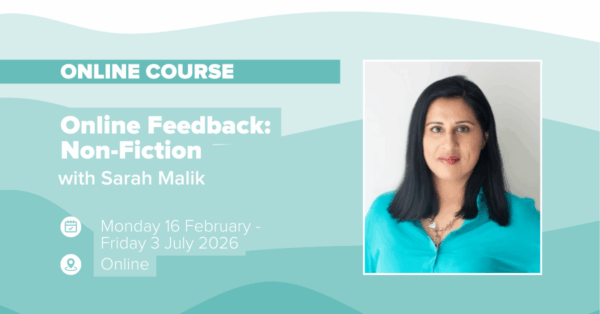
Join Sarah Malik for Online Feedback: Non-Fiction, Monday 16 February to Friday 3 July 2026 (5 months), online.
More from Writing NSW
Check out our full range of writing courses in Sydney, our online writing courses and our feedback programs to see how we can help you on your creative writing journey. Find out about our competitions and opportunities, as well as writing groups across NSW, and sign up to our weekly newsletter for writing events, opportunities and giveaways.