
Writers on Writing is our regular conversation with a writer or industry professional about the writing craft, industry insights, and their own practice. This week, we spoke to JP Pomare about pursuing narrative avenues that excite, and his advice for writers who keep starting novels but can’t seem to finish.
How do you come up with ideas for your novels? How can a writer find a story worth telling?
It’s hard to say exactly where my ideas come from – I might be walking, or reading, or falling asleep when I’m struck by an idea worth holding onto. When it happens I make a note of these ideas on my phone or in a notebook. If I’m still excited by that idea weeks or months later that’s when I know there might be a story there. The key is to be ready when inspiration comes.
When beginning a novel, what are your tips for plotting? Do you recommend planning every chapter, or sketching a vague story arc and letting the novel guide you?
My main tip for plotting is to follow your gut and let yourself go off track. Irrespective of how much you’ve plotted the story out before you set out to write, you should always be prepared to pursue the narrative avenues that most excite you. If you find it’s a dead end, then all you’ve lost is a little time but you could also find magic there. I don’t plan every chapter, but when I’m finishing up writing for the day I make sure I have one or two chapters planned out in advance. This helps me fall back into the story and kickstart my brain. I think when you start out it’s a good idea to at least have the beginning and end in mind, and a few key scenes you think are important to the story you want to tell.
What does it mean for a writer to have a strong voice? How can a writer improve their voice?
A strong voice is distinct, it has personality. It has a particular cadence, and rhythm that makes it impossible to ignore. The more you read, and the more you write the more you develop and recognise your own voice. That said there are a few exercises that can help – writing the same scene from different perspectives is a good one.
How can finding the right perspective for your story improve your draft?
Perspective is fundamental to the type of story you want to tell. First, second, third and omniscient all bring varying levels of intimacy, psychic distance, access and flexibility etc. The character or characters you choose to follow will also influence who the reader connects with, what they will see and feel and ultimately how they’re affected by the story.
What advice would you give to writers who keep starting novels, but never seem to finish?
There’s any number of reasons why someone gives up on a first draft but I think the most common is probably a loss of confidence in the project. To this I say: no one writes clean, publishable first drafts. Everyone’s first draft is terrible but the most important thing is persevering and getting it down on the page.
JP Pomare is a New Zealand author who lives in Melbourne, Australia. He is the author of a number of critically acclaimed and best-selling novels including Seventeen Years Later, Tell Me Lies, and The Wrong Woman. His novel In The Clearing was adapted for the screen as an eight part miniseries by Disney (The Clearing) and The Last Guests (Watching You) has been adapted as a series by Stan.
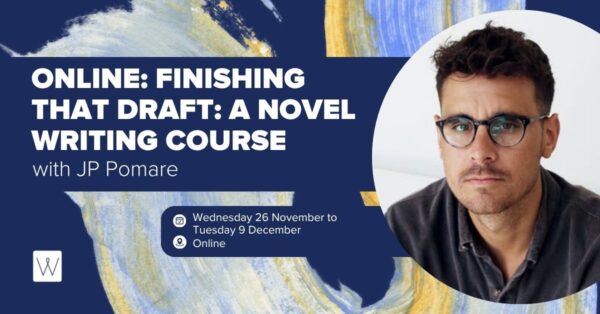
Join JP for his course, Online: Finishing that Draft: A Novel Writing Course, Wednesday 26 November to Tuesday 9 December 2025, online.
If you want to be the first to read great advice, prompts and inspiration from our incredible tutors, subscribe to our weekly e-newsletter Newsbite.
More from Writing NSW
Check out our full range of writing courses in Sydney, our online writing courses and our feedback programs to see how we can help you on your creative writing journey. Find out about our grants and prizes, as well as writing groups across NSW, and sign up to our weekly newsletter for writing events, opportunities and giveaways.