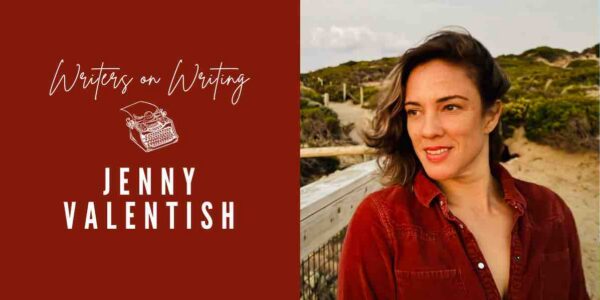
Writers on Writing is our regular conversation with a writer or industry professional about the art of writing, industry insights, and their own practice. This week, we spoke to Jenny Valentish about building an author ‘brand’, what publishers expect in terms of promotion and social media following, and how writers can create safe online boundaries.
What is an author brand and why do publishers care about it?
A divisive question right off the bat! So many authors will recoil from the word ‘brand’ – and certainly no one has to go full-tilt down the brand route. They might just choose to make their social media profiles more cohesive in terms of tone and the content of their posts (which is kinda branding, but we don’t have to call it that).
You could say that someone like Emma Gannon has a distinctive brand because she always pictures herself wearing bright colours and distinctive glasses and often uses the same picturesque corner of her flat as a backdrop. Or someone like Rosie Waterland, because her ‘brand’ of self-deprecating humour is present throughout her posts. Or Siang Lu, because he makes a lot of literary in-jokes involving other authors.
Maybe your brand is that you always like perving at books in bookshops and you take the reader with you. Or your dog does something adorable in the background all the time. Genre writers, such as fantasy writers, often delight in making posts that create world-building around their books, fleshing out characters and locations. People more comfortable with video might want to regularly talk directly to the viewer, TikTok style (something that Elizabeth Gilbert does a lot).
It’s all about figuring out what you’re comfortable with. Me, I like doing sardonic skits on the topics of my books (or just skits about being an author) – but the key thing is I do really enjoy doing that, so I don’t resent the drain on my time.
Do publishers expect writers to have a following on social media prior to publication?
If you’re a ‘mid-list’ kind of author and not someone they’re specifically approaching to write a book because of having a huge following, a publisher doesn’t expect you to have huge numbers. But they’d love it if you have an engaged following of people who visit your social media accounts because they know what to expect and they know they like it.
Maybe you’ve even established a community of sorts; for instance, having written an addiction memoir, I’m across the activities of sober authors, and quite often they’ve created a sober community by making posts about the sort of challenges and victories sober people face. Really homing in on your niche also allows you to use hashtags and pick up new followers who haven’t read your books yet.
Lastly, it’s sensible to only pick one social media platform on which to focus, so that you don’t waste valuable writing time getting across all the bases. I prefer Instagram and, when I’ve taught writers, I find that it’s usually their preference too.
Once a writer signs a publishing agreement, promotion seems like it would be the job of the publisher. Is this the case? Or should authors expect to self-promote their writing?
Your publisher will either have a publicist in-house or a freelance publicist. However, that person will be working across many, many titles. They will have some well-worn routes to try (it depends on your genre, but for non-fiction a common route is an extract in Sunday Life, an appearance on Today Extra, a spot on an ABC show like Life Matters and maybe a piece for The Guardian or Kill Your Darlings that they’ll get you to write). So other than that they probably won’t have time to think outside the box and they won’t have the capacity to continue promoting you once your book has been on sale for a month. That means it’s a great idea for authors to exploit any media contacts that they have and to come up with article ideas they can write that relate to their book. Just keep your publicist in the loop so that you don’t tread on their toes.
Why is it important for writers to create safe boundaries once they’re starting to put themselves and their writing into the world?
It’s probable that you’ve already opened a vein and made yourself vulnerable in the writing of your book, but at least you’ve done so within a lot of context and you are in control of the narrative. Once you’re in a radio studio with just 10 minutes for the host to extract your story, all nuance goes out of the window. To counter that, it’s good to be proactive by fashioning interested radio producers and journalists with some talking points that you’re comfortable with, and having a few engaging quotes and scenes up your sleeve that they won’t be able to resist using.
You have an engaged and impressive social media following. Did promoting yourself always come naturally to you?
I remember being quite terrified of Twitter when it came out, and even Facebook, because being conflict averse I didn’t want to express my opinions and potentially get embroiled in arguments.
Being an introvert, Instagram actually really suits me because with videos and pictures you’re talking AT people rather than WITH them. That may sound odd, since there’s a performative aspect, but think about how many lead singers and actors are introverts: they are attracted to those fields because they can express themselves without having to have a back and forth!
I do come up with quite a few video ideas that I abandon because they’re not working, and I’ve realised that what DOES work better for me is not to address the camera but to address someone else and bounce off them. It’s way more natural. I usually use my boyfriend as my patsy.
Journalist Jenny Valentish is best known for her deep dives into the human psyche. Her fifth book, The Introvert’s Guide to Leaving the House, is for socially awkward and socially reluctant people who could do with some game plans for excruciating social scenarios. Since 2015, she has taught memoir, media training, self-promotion, and journalism as a guest lecturer at universities, for literary events, and through her own workshops.
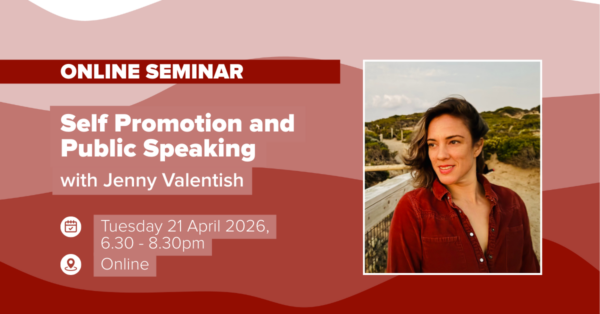
Join Jenny Valentish for Self Promotion and Public Speaking, Tuesday 21 April 2026, 6:30-8.30pm, online.
More from Writing NSW
Check out our full range of writing courses in Sydney, our online writing courses and our feedback programs to see how we can help you on your creative writing journey. Find out about our competitions and opportunities, as well as writing groups across NSW, and sign up to our weekly newsletter for writing events, opportunities and giveaways.