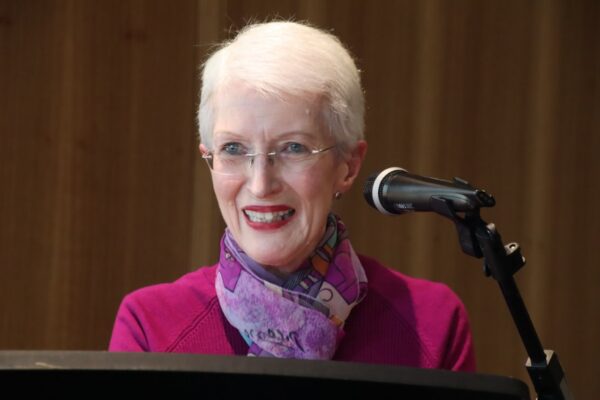
In our Spotlight On series, we chat with a member of the Writing NSW community to celebrate their success and learn more about their writing practice. This month author and poet Helen Lyne chatted with fellow writer Zita Fogarty and Writing NSW.
How long have you been writing? And when did you realise you had the talent to be a writer?
I don’t think of myself as talented. I’ve been writing for as long as I can remember! Writing is exciting and fun. To my mind, words, air, good food and champagne are the necessities of life. In pre-internet days, when overseas mail took weeks to arrive and international phone calls were expensive, I hand-wrote letters on foolscap-size paper describing my travel adventures. Without knowing it at the time, when I was teaching, I gathered lots of inspiration and ideas for my writing career, which hadn’t yet started. Writing school reports was great preparation and practice for writing fiction. Parents always want the truth wrapped up in roses.
This poem was inspired by that period of my professional life.
Parent-Teacher Night
His mum says he’s a genius
and destined for the law,
demands to know why his reports
consistently are poor.
I tell her as she glares at me,
aggressive, grim and haughty,
her nine-year-old’s a super kid,
cheeky, fun and naughty.
While working as a film extra, I found there were long periods of inactivity, and ample time to observe the dramas I witnessed on set, both by those being filmed and those in real life among cast and crew.
Do you have a regular writing routine?
As I am now retired, I can write anytime. Mornings are best; and I write every day. I usually find inspiration in the shower, or when I’m sitting in heavy Sydney traffic – neither situation being very convenient for jotting down ideas! Lockdown during COVID gave me the freedom to write at any time of the night or day, in dressing gown or trackies.
Do you draw inspiration from any particular writer?
One of my first inspirations for writing short stories is W Somerset Maugham – he had such a deep understanding of human nature. I appreciate that some may find his style a bit outdated now. I have just reread ‘The Snows of Kilimanjaro’, a short story Ernest Hemingway wrote in 1936 about a writer who, while in the process of dying, is confronting his mortality and lost opportunities as he looks back on his life. There is a profound depth of understanding in his writing.
Do you find inspiration from other sources?
My teaching career has been a great source, as I’ve already touched on, and the many places I’ve visited, like India, Algeria, Libya, Morocco, Iran, South-East Asia and, of course, France, my most frequent destination which I try to visit every year. I find ideas a lot closer to home as well – on the bus, or while visiting an art gallery for example. It helps to be a good listener, and a keen observer. I think all writers possess this ability. I also gather insights for my writing from people I know. I am privileged to have artist friends and have collected authentic details from visiting their studios.
You mostly write short stories and poetry. What attracts you to these writing styles?
I like brevity! Writing the novels was a useful experience. I sometimes go fossicking in them and extract a scene that I convert into a short story. I originally sent the novels to publishers and received rejections – I consider that as part of the process of being a writer, earning my credentials. Once you have written a novel you have it assessed. Then each publisher wants something a bit different: a 300 word or 500-word synopsis. Preparing submissions is not fun. I don’t ever finish a poem; I may get close to it. I sometimes change a word or a line as I’m standing at the microphone in front of an audience.
You’ve been a member of the Open Genre Writing Group at Writing NSW for many years now. What are the benefits of joining a writing group?
There is self-exposure when you read your work out to a group. I still feel that, even though speaking to groups of students, teachers and parents was a daily part of my working life. In a classroom and in meetings you get to hide a lot of yourself, so reading your work to a group is a very different dynamic. I like that in the Open Genre Writing Group there is so much diversity – people with different life experiences, ages, ethnicities and circumstances. They bring these elements of differentiation into their writing, too.
What would you say to anyone reading this who is thinking about self-publishing?
It was important to be able to speak to people who had worked with the same printer. Editing is also a pivotal part of the process. I had previously edited each story for possible entry into competitions and submission to anthologies. Most writers of longer works use professional editors, but I was confident that my editing had been rigorous. And of course, the input from the Open Genre Writing Group was invaluable.
What is Turnabouts about?
Most of the characters in the stories effect turnabouts in their own lives. The stories also reflect how social attitudes have and haven’t changed. ‘Unlocking Doors’ won the fiction section of the Society of Women Writers’ 2024 National Writing Competition. It spans the period from conscription during the Vietnam War to the present day. An old woman looks back at the treatment she received as a pregnant sixteen-year-old. Her parents hid her and the disgrace that she inflicted on them, and had the baby taken away the moment he was born. In the present day, a woman abseils out of an abusive relationship. In another story, a young man comes out to his grandmother.
Some stories are set in schools. In ‘Another First Day’, a primary school principal recognises the intelligence of a homeless Year 4 student who has had to adapt to numerous schools.
And then there are the cat stories. I may not be their literary equal, but I belong to the illustrious plethora of writers who loved cats. That ailurophile group includes Mark Twain, T. S. Eliot, Charles Dickens, Raymond Chandler, Ernest Hemingway, Alexandre Dumas, Colette and me! The cats in ‘A Perfect Couple’ and ‘Feline Fixer’ know what’s good for their human companions and behave accordingly.
You are always working on your writing – what is your current project?
Right now, I’m putting together a collection of poems. They’re all written, but each time I read them, I see the need for improvements, updates, deletions, additions or abandonment. The biggest conundrum is organising them. The large number of topics includes conservation, political satire, self-send-up, erotica, reactions to Covid and the death of a loved one. Tones range from silly to serious and styles range from rhyming couplets and iambic pentameter to free verse. I’m tempted to throw the whole collection in the air and take the order in which they fall.
There are competitions for poetry manuscripts. Spill the BeanZ currently has a manuscript competition open to members and Writing NSW has a list of ‘Writing Competitions & Opportunities.’ Self-publishing is always an option. The reactions of audiences at open mics can be exhilarating. They can also be sobering. Whether accepted, rejected, applauded politely or with wild enthusiasm, my poems were and are fun and challenging to write.
Helen Lyne’s almost forty-year career as a French and English teacher has taken her far and wide – from Melbourne and Sydney to Winnipeg on the Canadian prairies and Reims in the Champagne district of France. She is passionate about the written word, French culture and international travel.
Since retiring from teaching at the age of 58, Helen has built two more careers: one as an extra in films and television and one as a writer of fiction and performance poetry. Her published work includes a collection of short stories, Love, Disappointment and Other Joys of Life, (Ginninderra Press, 2021) and chapbooks, At the open mic and Performance Poems (Ginninderra Press, 2022 and 2023). Other short works have been published in anthologies and magazines and online. Two novels are still sleeping on her computer.
To celebrate her 80th Birthday in April this year, Helen launched Turnabouts, an independently published collection of short stories.
Learn more about Helen at here.
Read about past Spotlight On writers here.