In our Spotlight On series, we chat with a member of the Writing NSW community to celebrate their success and learn more about their writing practice. This month we chat with writer and cultural consultant Shannon Barnes.
Your first work, Strangelands, won the inaugural Bundyi prize and is being published through Simon and Schuster’s Bundyi imprint next year. Tell us a bit about your work?
Strangelands is a multi‑generational literary fiction novel set on Ngiyampaa Country, following the Yawatyal‑Harris family as they navigate grief, kinship, silence, and the spiritual currents that shape their lives. It explores how trauma moves through generations, how culture endures in everyday moments, and how Country continues to call us home.
At its heart, the novel is about the fault lines that shape families – and the old, patient forces that help steady them. Kennedy Harris, a single mother in her fifties, begins to reckon with the parts of herself she set aside while raising her children. When her past resurfaces, she must confront its trauma and the long-held silence she believed had protected her family. Her journey reflects a truth many women know: healing and clarity often arrive later in life, and they rarely belong to one person alone.
Strangelands also asks a quiet but powerful question: what if nothing had been stolen? What if our families had been allowed to remain whole? Through the Yawatyal‑Harris family, the novel shows that sometimes all you need is a refusal to give in, your culture, and your Country.
My storytelling is non‑linear, just like culture itself – the novel moves across past, present, and future all at once, reflecting the way our stories truly live.
How does it feel to be the inaugural winner of theThe Bundyi Prize? Has it put pressure on you that you were not expecting?
I can’t fully explain how it felt to be the inaugural winner of the Bundyi Writing Prize last year. Can you imagine answering that call? I was so overwhelmed to be speaking with Dr. Anita Heiss that I couldn’t contain my emotions. It’s an honour I’ll carry forever.
What surprised me is that the award hasn’t put pressure on me at all. If anything, it’s supported my growth and given me even more confidence. Anita has curated an incredible team, and I credit them with helping me shift from being a “writer” to being an “author.” The whole experience has been positive, comfortable, and deeply fulfilling. Yes, editing was hard – but anything worthwhile usually is.
I went into the process with no expectations beyond wanting to make my family proud and produce a manuscript worthy of landing in readers’ laps. I feel like I’m doing that, and the Bundyi Prize has simply strengthened my belief that I’m on the right path.
In a previous interview you said that that you’ve ‘kept your stories close’. What motivated you to put them on paper?
I always wrote. My mum used to make me little books as a child – she’d write them and staple them together with her own illustrations inside. She was my first storyteller; she taught me to love books and not just read but to write. I hope one day to publish her children’s story in her honour. Wouldn’t that be an incredible thing?
Although I kept writing as I grew, I never shared anything. My cousin is an author and she encouraged me to enter into a competition. I won a highly commended award and that was the beginning of me finding my voice and courage to show my work to others. I kept entering things and I won a couple of sections in things with short monologue-style stories.
It wasn’t so much the accolades that encouraged me to keep going – more the people in the literary world. They embraced me and made me feel like I was family. It was really refreshing to land in an environment that was so nurturing after many years in business where everything is competitive.
I just love writing. It makes me happy and its people are my kind of people.
What advice do you have for emerging writers?
I still feel like an emerging writer myself, but the best advice I can offer is to build discipline. I write every day- sometimes well, sometimes terribly, sometimes for hours, sometimes for minutes. The point is simply to show up. That daily practice teaches me commitment more than any single piece of writing ever could.
I’m fortunate to work for myself, which means I can shape my schedule to make space for writing and for learning. I’ve taken full advantage of the online courses offered by Writing NSW and the Australian Society of Authors, and I cannot recommend them highly enough. There is so much wisdom shared by talented, generous creatives, and I think we owe it to ourselves to absorb that generosity – and then pay it forward.
Those courses, and the communities around them, helped me find my writing family. I’m surrounded by incredible creatives and continue to meet more along the way. Being part of that environment has given me confidence, and that confidence is what allows me to back myself.
In life- I’ve lived that saying with a bit more mongrel: back yourself. No one is going to do the hard days for you. No one will build the world you want and hand it to you. That’s your job. So back yourself.
I don’t feel entirely qualified to give advice, but one thing I learned early was to take feedback positively. You can learn from everyone. I try to see the value in every part of this journey, even the uncomfortable bits, because they all move you forward.
You come from Ngiyampaa country and live on Wiradjuri country. How has living on or close to Country shaped your writing?
My Grandmother’s Country is Ngiyampaa Country. I’ve never lived on my ancestral homelands, so my connection to Country is through her lessons, passed down to me through my father’s love. He made learning about Country a priority. My whole childhood was spent in the bush with him or sitting on a riverbank with a fishing rod. That was how I learned to listen to Country and learn about culture – that said, it is an eternal lesson and I am grateful for all of my Elders who taught me things throughout my life. Without all of them, I wouldn’t be the woman that I am.
I’ve lived on Tubba Gah Wiradjuri Country for seventeen years now, and even though we’re “off Country”, it has become home. I’m a bush girl through and through – I couldn’t live anywhere without a river nearby or the ability to drive out of town and be surrounded by Country’s unfiltered beauty. That’s where I belong, although I love going home to my Grandmothers Country. There is no feeling like it.
Living close to Country shapes my writing in two big ways. Narratively, it gives me richness and authenticity. I write from lived experience, so I can bring colour, texture, and sensory detail to the page. I want readers to see it, smell it, touch it, and feel like they’re standing in it. Storytelling also feels like a continuation of cultural practice. My children are all practitioners – an artist, two carvers, and a dancer – but until recently, I didn’t see myself as creative like them. Writing has given me a deep sense of cultural pride and a place within that creative lineage.
Career-wise, though, I’ll be honest: it hasn’t always been easy. Growing up, I didn’t get the exposure to the creative arts that I wish I’d had. Writing can be one of the least visible art forms for young people, and I didn’t know how to find my way into it. That’s why I’m so grateful for the online platforms and learning opportunities available now. They’ve opened doors that once felt out of reach, and I’m thankful to the industry for making space for people like me to learn, grow, and participate.
You are a business owner and mother of four. How do you fit in being a writer?
My children are now adults, but when they were young I was raising them alone while running a business. I had no time for myself, for creativity or anything outside those two responsibilities. It’s taken reaching my fifties to finally have the space to write something substantial, and I’m grateful that all those years of hard work have given me the freedom to do that now.
That said, I do wish I’d found the space earlier. Writing has brought me so much joy and peace. There’s something incredibly liberating about stepping into your creative mind – away from pressure, away from deadlines – and learning new skills, building worlds, and giving life to characters you believe deserve to exist. It’s an exceptional feeling.
I think everyone deserves the privilege of giving themselves that creative space. It’s healing. It’s restorative. And it does something powerful for your wellbeing when you allow yourself to create simply because it brings you alive.
What are you working on now?
I’ve just finished a set of monologues for an international film and short script festival I enter each year called Voices of Women. I also volunteer at a local aged care facility where we run a book club, and I write a short story each month to read with the residents, which is something I really treasure.
The most exciting thing, though, is that I’ve just completed the first draft of my second manuscript, Seldom Seen. It sits alongside Strangelands in the broader world of the Yawatyal‑Harris family, but my books don’t run in a strict linear sequence. They move through the family’s story in different directions, exploring different threads and perspectives. Seldom Seen is another part of that tapestry.
There’s still plenty of work ahead on it, but that’s all I can manage right now because I’m in the middle of editing Strangelands for publication. It’s a busy creative season, but a deeply fulfilling one.
What are you currently reading?
I’m just finishing Code Name Hélène, a historical fiction novel by Ariel Lawhon. I love historical fiction, and earlier this year I really enjoyed The Butterfly Women by Madeleine Cleary as well.
I also make a point of reading and supporting debut authors like Judi Morison, Anna Johnston, Brooke Crawford and Anne Freeman. There’s something special about discovering new voices and being part of their early readership.
And I’ll admit it: I’m a sucker for a good rom‑com. Of course, I’m going to say Anita Heiss – she’s the rom‑com queen. I also love Jenna Lo Bianco’s work because honestly, what’s not to love about a story set in Italy?
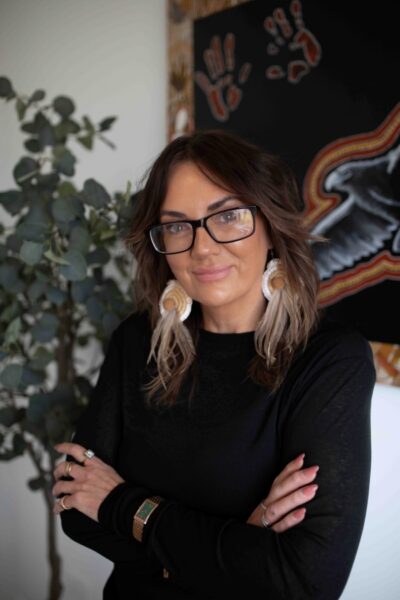
Image courtesy Alicia May Photography
She lives and works in Dubbo, on the land of the Wiradjuri nation.
Learn more about Shannon here, or follow her on Instagram or Facebook.
Read about past Spotlight On writers here.