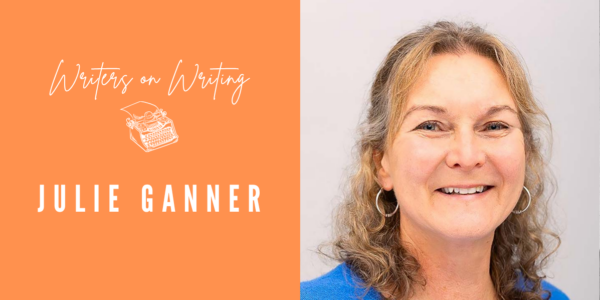
Writers on Writing is our regular conversation with a writer or industry professional about the writing craft, industry insights, and their own practice. This week, we spoke to Julie Ganner about her journey to realising the importance of writing for accessibility and inclusion, misconceptions surrounding accessible writing, and how writers can incorporate inclusivity in their own practises.
What was your journey to realising the importance of writing for accessibility and inclusion?
It began in 2017, when I was asked to be the national editors’ representative at an accessibility forum in Sydney, convened by the Australian Publishers Association.
If I’m honest, I didn’t really expect a lot more from the forum than to meet some interesting people over a few nice sandwiches. However, what I heard that day turned me upside down. The other participants were a well-informed and passionate group from across the publishing, disability and government sectors. They articulated a swathe of problems for readers with print disability that, until that moment, I’d been completely oblivious of.
As an editor and writer, it’s my job to ensure ideas are communicated clearly to the reader, and of course I love reading. So I was mortified to realise I’d never before given much thought to how people can read the material I’ve worked so hard on if they can’t see, hold or manipulate a printed book. I also hadn’t considered how someone can understand my content if it relies on senses they’re not able to use.
In other words, I’d been ignoring the needs of a significant sector of my readership!
It quickly became clear that this was an issue that the publishing industry could and should tackle. In 2019, I co-wrote Inclusive publishing in Australia: An introductory guide, and in 2020 I set up a working party through the Institute of Professional Editors (IPEd) to develop guidelines and training on accessibility issues.
In the beginning, our IPEd group envisaged creating just a short guide for writers and editors. However, we soon realised that this issue affects everyone in the publishing workflow, and each part of that workflow affects the next, so addressing only some areas of it wouldn’t be enough. This led to the development of Books without barriers: A practical guide to inclusive publishing, which covers the whole publishing process from concept and planning to publication in multiple formats. That process is often referred to as creating books that are born – and even conceived – accessible.
What are some common misconceptions about making writing accessible?
One is that accessibility is a niche issue that affects only a small proportion of our potential readership: people who are blind.
In fact, accessibility issues are likely to affect all of us at some point in our lives. This could be through a permanent condition, an age-related development (my eyes are definitely not as sharp as they used to be!) or even just a temporary impairment, such as having a broken arm. And let’s not forget readers who choose to listen to audiobooks, whether or not they have a disability. The content has to be accessible to them too.
Another misconception is that all digital content is automatically accessible and therefore provides equal access to people with print disability. This is far from the truth. If the content isn’t developed with accessibility in mind – from the language used to the illustrations that accompany it – a reader may not be able to follow some or all of it, no matter how it’s presented to them.
Other misconceptions are that addressing accessibility issues is difficult, and that doing so may detract from the text in some way. We’ve found the reverse to be true. For example, formatting your manuscript correctly is a straightforward task that benefits all readers, as it makes the text easier to read and navigate. And of course, writing that appeals to all the senses, rather than sight alone, is simply good writing.
Is it just the publisher’s job to make writing accessible to a wide range of readers, or can an author help with this too?
Everyone involved in publishing a book has a role to play in making it accessible, beginning with the author.
Accessible and inclusive publishing is not just about formats: accessibility considerations must be built into the creative process too. The best technology solutions in the world can’t fix writing that excludes some readers from participating. Assistive technologies such as screen readers and braille are terrific, but they are effective only if the content is understandable through hearing and touch as well as sight.
Why should writers be interested in learning an audience’s diverse reading preferences?
According to the Australian Bureau of Statistics, one in five Australians identify as having some form of disability. A significant number of these conditions will affect the person’s ability to read printed material. That’s a lot of people we may be unintentionally discouraging from buying our books if we don’t address their reading needs adequately!
I can’t imagine that any writer would want to deter people from reading their work. Yet this is effectively what we may be doing if we don’t cater for the diverse needs of our readers. And of course to be able to do that, we need to have a clear understanding of what those needs are in the first place.
This is also a social issue. Imagine what it would be like if you suddenly found you couldn’t read the majority of the books in the world because of the way they were written and produced. Yet this is the experience of many people living with print disability.
Everyone has the right to participate fully in society’s cultural activities. As writers, we should be even more aware of this than most. So it’s up to us to help make sure anyone who wants to read our work can do so, and that we don’t prevent them by inadvertently placing barriers in their way.
Julie Ganner AE is an accredited editor over 30 years’ experience in the publishing industry. She runs her own freelance editing business, lectures in editing and proofreading at The University of Sydney, and provides professional training in accessible publishing for writers, editors and publishers. Julie is an honorary life member of the Institute of Professional Editors, and was awarded the Janet Mackenzie Medal in 2025 for outstanding service to the editing profession. She is co-author of Inclusive publishing in Australia: an introductory guide and Books without barriers: a practical guide to inclusive publishing.
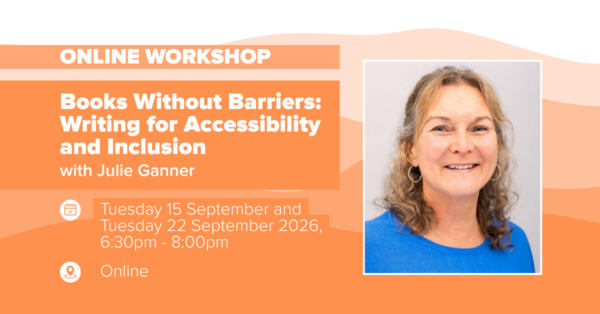
Join Julie Ganner for Online: Books Without Barriers: Writing for Accessibility and Inclusion, Tuesday 15 September and Tuesday 22 September, 6:30-8:00pm online.
If you want to be the first to read great advice, prompts and inspiration from our incredible tutors, subscribe to our weekly e-newsletter Newsbite.
More from Writing NSW
Check out our full range of writing courses in Sydney, our online writing courses and our feedback programs to see how we can help you on your creative writing journey. Find out about our grants and prizes, as well as writing groups across NSW, and sign up to our weekly newsletter for writing events, opportunities and giveaways.