
Why would a writer want to unsettle their readers? How can a sense of disquietude contribute to an author’s writing?
I was recently invited to read a picture book at my son’s preschool, and one of the children asked me a similar question. Mind you, they didn’t use the word “disquietude”—and I suppose that if they had, that would’ve been pretty disquieting. I mean, what young child has that sort of vocab?
But the circular answer I gave is probably the correct one: a writer might want to unsettle their readers because so many readers enjoy being unsettled. I certainly count myself among them. If a novel is unnerving, I appreciate the little spike of adrenaline I get. I like that a measure of the fight or flight response kicks in. My eyes move ever more swiftly over the words. Simultaneously, I know that the disquietude is limited to what I’m reading, so all I’m truly being threatened with is a possible paper cut and a good time.
More deeply, material that disquiets does have a way of burrowing under a reader’s skin and stealing into their mind. It overleaps proper conscious consideration and lodges somewhere in the unconscious, to gnaw at a reader and be gnawed at by them. There it lies, frustrating neat processing while forcing them to attempt to process it. And this is what a sense of disquietude can contribute to an author’s writing: your work can become a ghost in a reader’s mind long after they’ve turned the last page.
What does it mean for terror and suspense to be meaningful for characters and readers?
As elements of storytelling, terror and suspense are present in many novels, short stories and films. There have to be stakes of some description; an outcome has to be unknown, hanging in the balance. Something has to demand that people keep paying attention to it. Much of the time, though, terror and suspense in fiction and film are of the broadest kind: can the superhero stop the supervillain before the latest looming apocalyptic catastrophe comes to pass?
For terror and suspense to be meaningful, it has to engage with, emerge from or reveal the unique psyche of the character that experiences it. This means that before a writer can craft meaningful terror or suspense, they have to create a character with psychological depth. Once they have that, they should become a master of dreamscapes whose aim is to generate a nightmare — grounded or otherwise — specifically designed for that character.
This is not quite enough, of course, because a writer is also involved in the task of making meaning for readers. Hence, the aforementioned nightmare needs to be both deeply personal for the character… and yet, for a reader, nothing at all like hearing the tale of someone else’s dream. There has to be a dimension of the experience that is universal or worthy of empathy for the terror or suspense to unnerve readers and to be carried by them beyond the novel.
On that note, naïve though it may be, I still believe in fiction’s capacity to change readers’ minds, or at least to nudge them ever so gently. Cesar A. Cruz said, “Art should comfort the disturbed and disturb the comfortable.” Meaningful terror and suspense, with its prodding of the amygdala and capacity for subtext, provides authors with an unparalleled opportunity to do this. An author can engage with complicated themes, philosophical and political ideas, all while the loaded dice are being rolled by our protagonist or she’s trying to figure out how the vampires are selecting their victims.
What are some key questions a writer can ask about a character’s inner world to notice potential for terror?
Terror can arise from any corner of the psyche, since we’re all neurotics of one kind or another (right?). We all have doubts and anxieties, as well as unprocessed knowledge, thoughts or events swimming about in our heads. We each have an unconscious that’s like a broth that sometimes sends up a bubble to pop on the surface of our conscious mind.
When an author creates a character, that character should have strengths and weaknesses, backstory and blind-spots. Once the character makes the move from the theoretical to the written, they will ideally attain all of the traits that make a human being — including what I mentioned above.
If an author wants to create terror for that character, they should examine the character’s psyche and zoom right in on that which the character does not want to look at. What of the character’s inner world is ignored, suppressed, pushed out of focus? What about themselves disturbs them to such an extent that they wish they could go on ignoring its very existence? What is their worst nightmare, and how can this manifest in the real world?
Mind you, the external world is already full of terrors of its own, and much of what I’ve said about the psyche can probably be said of society. Terror that disturbs a character on a deep level and unearths something that we as a society want to bury can be the most disquieting of all.
How can a writer build suspense into their plot?
In a general sense, suspense is easy: make the reader have to know the outcome of something — and attach serious stakes to the answer. There are myriad ways of doing this, and suspense is all over the place (including, technically, in this response, which will continue shortly, very shortly, as soon as this parenthetical is over, in fact, so right about… now).
But building suspense that actually has the reader on the edge of their seat is a difficult thing to master. How can a writer use limited point of view or dramatic irony in a scenario? How long can a sequence or scene of suspense go on before it becomes tedious? How can any catharsis be made satisfying?
Perhaps the key is this: suspense should be meaningful for the character’s arc. For example, a tense situation could shock the character into a state of introspection. It might reveal or interrogate those parts of the character that they did not wish to see. Or it might present to them a morally weighted choice in a high stakes situation. Whatever the underlying aspects of the scenario, suspense should play a consequential role in the character’s journey of change, while also entertaining and disquieting readers, of course.
What are some great examples of disquietude in Australian novels?
One excellent recent example of disquietude — which oddly called to my mind HP Lovecraft’s The Rats in the Walls—is the use of a widespread rodent infestation in Charlotte Wood’s Stone Yard Devotional. Not only are the vermin themselves lurking in every crevice, but they impinge on the main character from the outside world and reveal her to be a part of it still. They unnerve and have both psychological and philosophical meaning that’s primarily conveyed through subtext.
For an off-the-beaten track pick, I quite enjoyed Alan Baxter’s inventive Tales from the Gulp. It’s set in an isolated Australian town where the bizarre is the underside of the mundane. And the main scene that I think about in that book is one that involves somebody sucking on an eye while being watched by the eye of another. The novel involves fun disquietude of the grown-up RL Stine variety, yet it’s not without depth of its own.
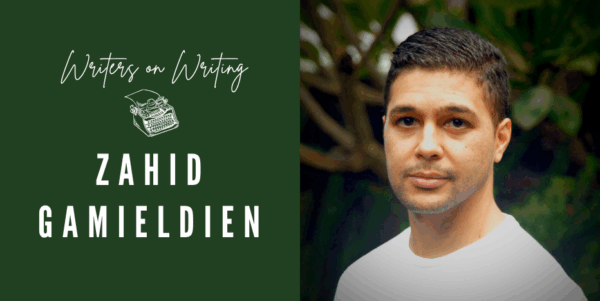
Zahid Gamieldien is an author, screenwriter, editor and writing tutor. His debut novel, All the Missing Children, was published by Ultimo Press in 2024. He’s had short fiction published in literary journals including Overland, Meanjin, Kill Your Darlings, Island Magazine and many others. His work was listed for the Richell Prize and selected for inclusion in the ‘best of’ fortieth anniversary edition of The UTS Writers’ Anthology. His unproduced screenwriting has been listed for awards in Australia and overseas, and as an editor and writing tutor he’s helped several authors get their work into print. He’s received funding to undertake a residency at Varuna House and two major arts grants from Create NSW. His latest short story is forthcoming in Overland, and his second novel will probably be released in late 2026.
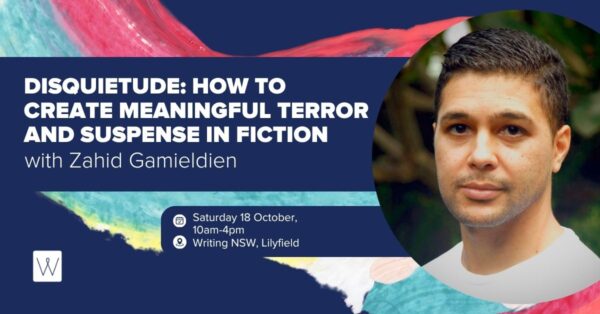
Join Zahid Gamieldien for his course, Disquietude: How to Create Meaningful Terror and Suspense in Fiction, Saturday 18 October 2025, 10am-4pm at Writing NSW.
If you want to be the first to read great advice, prompts and inspiration from our incredible tutors, subscribe to our weekly e-newsletter Newsbite.
More from Writing NSW
Check out our full range of writing courses in Sydney, our online writing courses and our feedback programs to see how we can help you on your creative writing journey. Find out about our prizes and opportunities as well as writing groups across NSW, and sign up to our weekly newsletter for writing events, opportunities and giveaways.