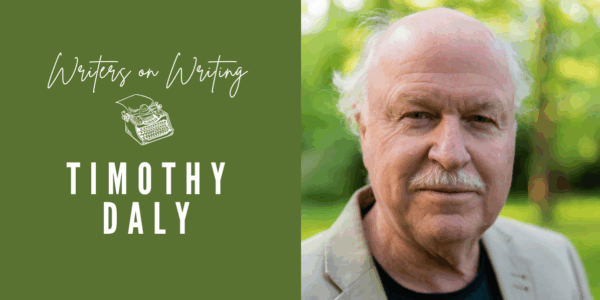
Writers on Writing is our regular conversation with a writer or industry professional about the writing craft, industry insights, and their own practice. This week, we spoke to Timothy Daly about micro-structures, advice for planning narrative structure, and the benefits of breaking conventional narrative structure.
Is narrative structure the same as plot? If there is a difference, what is it?
Technically, ‘narrative structure’ is how you reveal the plot. Do you tell the story backwards, or in chronological order, or mix time periods etc; while ‘plot’ can be defined as the series of events in that cultural and narrative convention called ‘a story’. But as a creative artist who’s always asked himself one question, “How excited am I by the story I’ve found—or created?” I always set myself one early task—to let the story tumble out, as quickly as possible, in any order that occurs to you in the delighted moment of creative pleasure and written expression that others call ‘writing’. Afterward, when you’ve calmed down, you can have fun experimenting with the order of the telling of those events. But, honestly, the only reason one ‘studies’ narrative structure at all is to train the conscious self in possible (and optional) patterns of story-telling, so that the merging of the unconscious self (where stories truly begin) and the conscious self happens, all by itself. Overnight (literally) you become a better writer and story-teller, simply by having studied the age-old conventions that humans have devised for telling each other rich and meaningful stories.
What is a micro-structure in fiction writing and how does an understanding of that enhance a writer’s manuscript?
By all means, have fun and experiment with ‘micro-structure’, but the real point of writing and story-making is to achieve conciseness and coherence. The fewer words you need, the better. But ‘brevity’ is not a goal in itself—it’s a means to an expressive end.
What advice would you give to someone just about to start writing a story, to help them plan their narrative structure well?
I would give such writers six words: the power of the bullet point. What I call ‘bullet point plotting’ is one of the most useful ‘trainers’ of structure in storytelling that I’ve ever stumbled across. It works for fiction, theatre, TV and film. Basically, without any (initial) recourse to so-called beautiful writing style, you list ‘what happens next in the story’. Each concrete and separable moment is given a bullet-point, initially, in chronological order or the order of increasing psychological and emotional significance. Doing this forces the writer, to realise, first, how little plot s/he actually has, and second, if that is actually a problem! But at the very least, it allows you to think of your writing in terms of the story you are telling.
Can you give us an example of a work of fiction which knowingly broke conventional narrative structure – with an incredible result.
I’ll never forget the impact of reading Perfume by the German writer Patrick Susskind. It didn’t break with convention so much as transform it by its rich, imagistic detail and a sense of wonder. The plot raced to its amazing conclusion – a technique I’ve never forgotten.
Timothy Daly is one of Australia’s most internationally produced playwrights, with a string of national and international productions to his credit. Actors such as Academy Award-winners Cate Blanchett and Geoffrey Rush have appeared in his plays. His 2008 play, Derrida In Love, was written expressly for the 2011 Academy Award nominee, Jacki Weaver. His play Kafka Dances has won over a dozen national and international awards since its première, and is the most internationally performed Australian play of all time. His recent play The Man in the Attic was awarded Australia’s most prestigious award for a new play, the Patrick White Playwrights’ Award, and has just been performed in Paris. Timothy Daly’s newest play Richard III (ou presque) premiered at the 2010 Festival of Avignon, followed by a season in Paris in Oct – Nov 2011. Timothy Daly has been a literary judge in most categories for the Australian Writers’ Guild AWGIES, The NSW Premier’s Fellowship, and the Premier’s Literary Awards. He has taught extensively in Australia and overseas, and was a Featured Artist at the 2014 and 2016 Valdez Last Frontier Theatre Conference. His radio plays have been broadcast in six countries, and won an AWGIE and an AWGIE nomination. In 2012, Timothy Daly began a professional relationship with Los Angeles-based producer Victoria Wisdom for the production in the US of his theatre and film work. He advises on over 100 plays and productions a year both in Australia and the US.
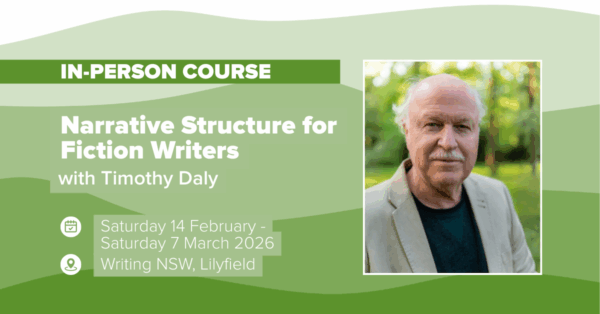
Join Timothy Daly for Narrative Structure for Fiction Writers, 4 x Saturdays: 14, 21, 28 February, 7 March 2026, 1pm-4pm.
More from Writing NSW
Check out our full range of writing courses in Sydney, our online writing courses and our feedback programs to see how we can help you on your creative writing journey. Find out about our competitions and opportunities, as well as writing groups across NSW, and sign up to our weekly newsletter for writing events, opportunities and giveaways.