Year of the Novel: In Person
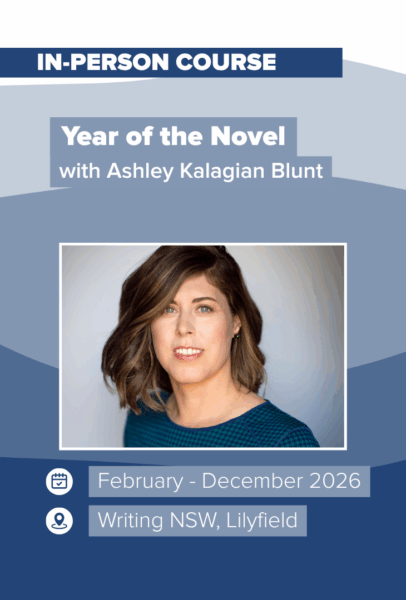
 Ashley Kalagian Blunt
Phase One: 8 x Wednesdays: 4, 11, 18, 25 Feb; 11, 18, 25 March; 1 April 6:30-9:30pm
Phase Two: 8 x Wednesdays 13, 20, 27 May; 3, 17, 24 June; 1, 8 July 6:30-9:30pm
Phase Three: 8 x Wednesdays: 23, 30 Sept; 7, 14 Oct; 4, 11, 18, 25 Nov; Celebration: 2 December 6:30-9:30pm
Full Price: $2850
Member: $2125
Conc Member: $1850
This course is closed for bookings. Sign up for our waitlist here to find out when it’s running again. In the meantime, check out our list of current courses or sign up for our Newsbite weekly newsletter for updates.
This novel writing course, Year of the Novel with Ashley Kalagian Blunt, will be held at Writing NSW in Sydney.
Make 2026 the year you finally write that book in this course from bestselling author Ashley Kalagian Blunt. Over three phases of eight weeks each, you’ll receive the tools, support and encouragement you need to plan, write and edit your novel.
Is this course right for you? Read our FAQ before enrolling>>
Course Overview
We’ll start by getting the bare bones of your novel down on paper (or screen). In the first phase, we’ll discuss generating ideas and planning, and look at the basic elements of fiction – point of view, voice, narration, character, plot, dialogue and setting.
In the second phase we’ll put some flesh on the bones of your novel, looking at structure and narrative drive, and going deeper with character and plot. As we approach the year’s half-way mark we’ll also talk about how to stay focused and motivated to see this thing through to the end.
Finally, in phase three, we’ll work on turning your very good novel into a brilliant one. We’ll cut the fat, plump up the too-lean bits, polish the language and ensure you have the knowledge and skills necessary to launch your novel into the world.
Throughout, Ashley will use examples from both contemporary fiction and students’ works-in-progress to explore the topics covered, and guest speakers will share their insights to further expand your understanding of how published writers do what they do.
To fully immerse ourselves in how novels work, we’ll refer throughout the year to Eleanor Oliphant Is Completely Fine by Gail Honeyman. You’ll benefit from reading this award-winning debut novel prior to the start of the course or during phase one.
At the end of the year, we’ll celebrate your accomplishments by throwing a party at which friends, family, other writers and industry insiders can hear you read from your novel.
You should come to the first class with a specific work-in-progress or idea for a novel, and be prepared to share and discuss throughout the year. There will be ample opportunity for you to speak to the group about how various techniques and lessons may be applicable to your specific project; however, one-on-one detailed feedback from the tutor will be limited.
To benefit from this course, you should be working on a novel. You can contact us with any questions before enrolling.
Phase One: Writing the bones
This phase is all about getting the bare bones of your novel down on paper (or screen). We’ll talk about generating ideas and planning, and look at the basic elements of fiction – point of view, voice, narration, character, plot, dialogue and setting.
- Introduction and planning
Setting goals, creating structure, identifying obstacles and figuring out ways to get past them.
- Inspiration
Generating ideas, re-invigorating memories, stealing from life, and making the old and tired, vigorous and new.
- The building blocks of story
An introduction to the building blocks of story, including the difference between story and plot, and how you can make one into the other.
- Character and dialogue
What makes a character complex and compelling, and how can you make your characters as alive on the page as they are in your head? We’ll discuss how brilliantly written dialogue can make your characters more believable.
- Point of view and voice
We’ll consider the advantages and disadvantages of first, second and third POV, and which works best in what circumstances. We’ll also explore the relationship between POV and voice.
- Narrative drive
The difference between suspense, tension, pace, momentum and narrative drive, and discuss why these are essential to the concept of story.
- Showing and telling
Beginner writers are often told to ‘show, not tell’, but it’s not as simple as that. We’ll talk about the difference between showing and telling, and how to get the balance right.
- Setting and progress review
Using the details of time and place to create atmosphere and solidify your invented world. We’ll also review our progress over phase one and forward plan.
Phase Two: Muscles, guts, flesh and blood
Phase two is all about putting flesh on the bones of your novel, giving your story depth and force and vigour by looking at structure, style and theme, and going deeper with character, voice and plot. As we approach the year’s half-way mark we’ll also talk about how to stay focussed and motivated to see this thing through to the end.
- Workshopping what needs to be done
It’s time to take stock of your work in progress, and set yourself up for success in phase two.
- Macro structure
Structure is what turns a collection of scenes into a satisfying novel. We’ll talk about scene beats and story arcs, and look at common structural templates.
- Advanced plotting: scene structure
We’ll go deep into understanding how scenes work and how we can strengthen ours.
- Character and emotion
How can we use emotion to propel our story forward while revealing character? We’ll consider how messy and conflicting emotions drive story, and discuss power dynamics.
- Backstory and subplots
We’ll look at backstory, time-jumps, transitions and subplots.
- Voice, tone, style
What is voice and how do you find, or develop, yours? What’s the relationship between voice and tone? We’ll talk about metaphor, imagery and finding the exact right word every time.
- POV: going deeper
How does ‘head-hopping’ differ from omniscient POV? And why does any of this matter? Can’t we just tell the story as it comes out? Answers to these questions and more as we dive deeper into the wonders of POV.
- Forging on
We’ve been working on our novels for over half the year by now. It’s time to talk about smashing writer’s block, pushing through frustration and dealing with doubt.
Phase Three: Nip, tuck, primp and preen
This is where we take a long hard look at your very good novel and figure out how to make it brilliant. We’ll cut the fat, plump up the too-lean bits, polish the language and do whatever else is necessary to ensure your novel is ready to face the world.
- Revision and editing basics
Learning to read like an editor, and the difference between structural, line and copy-editing.
- What’s missing?
Every novel-in-progress has weak points and this week we’re going to confront yours head on. We’ll review common problems and explore strategies to fix them.
- What needs to go?
You’ve done a lot of work since you first began this writing journey. Now it’s time to go back and pull down the stuff you no longer need. We’ll pull out the scissors and ruthlessly cut out all those no-longer necessary explanations, descriptions and conversations.
- Beginnings
It may seem a bit late to be talking about beginnings, but it’s often only once you’re close to the end that you can see where you should have begun! This week is all about making sure your novel starts where and how it needs to (now that you know where it’s going).
- Endings
Endings are tough, but we’re going to be tough right back at them! We’ll talk finales, climaxes, cliffhangers, epilogues, and the difference between an open or ambiguous ending and no ending at all.
- Word by word
This week we go micro, considering the rhythm and flow of sentences and hunting down filter words, cliches and clumsy constructions.
- Over to you
This week’s content will be determined by the needs and concerns of the students, and will include one-on-one time with the tutor for each writer.
- Where do we go from here?
Freelance editors, manuscript assessment, agents, publishers, competitions and more.
Participant Requirements
Pen and paper or preferred device for writing. Ensure your device is charged. Please read Eleanor Oliphant Is Completely Fine by Gail Honeyman prior to the course start or during phase one; it may help you to have your own copy to refer to. You should come to the first class with a specific work-in-progress or idea for a novel.
This course is designed for writers of fiction. If you have a narrative non-fiction manuscript and are interested in enrolling in this course, please contact us to discuss.
Please note: The in-person and online streams of Year of the Novel are completely separate, so please choose carefully at enrolment. We’re unable to offer transfers between the streams once your place is confirmed.
Phase 1 of Year of the Novel can now be booked as a standalone course. To enrol in Phase 1 only, please visit the Year of the Novel (Phase 1) page. Please note: participants who enrol in the full year receive a lower overall fee than those booking each phase individually.
More from Writing NSW
Check out our full range of online and in-person writing courses and our feedback programs to see how we can help you on your writing journey. Find out about our prizes and opportunities, writing spaces, as well as writing groups across NSW, and sign up to our weekly newsletter for writing events, news and giveaways.