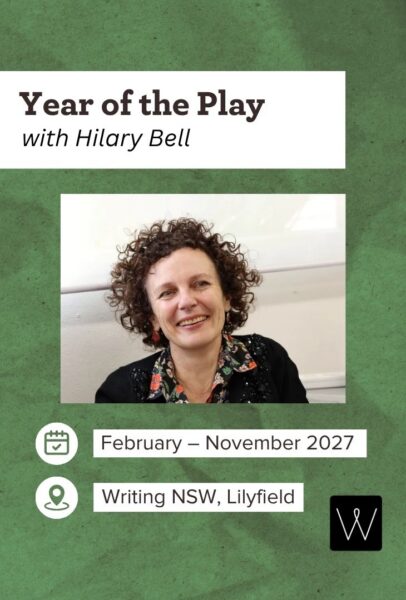
Year of the Play
 Hilary Bell
Thursdays 6:30pm-9:30pm
Phase One: 18 Feb – 15 Apr (break 18 Mar)
Phase Two: 27 May – 22 Jul (break 24 Jun)
Phase Three: 16 Sep – 18 Nov (breaks 7 Oct and 4 Nov)
Special End of Year Celebration: 25 Nov
Full Price: $3250
Member: $2450
Conc Member: $2150
This play writing course, Year of the Play with Hilary Bell, will be held at Writing NSW in Sydney.
Make 2027 the year you finally write that script in this comprehensive course from acclaimed playwright and tutor Hilary Bell. Over three phases of eight weeks each, you’ll receive the tools, support, and encouragement you need to plan, write, and refine your stage play along with tips and tricks for helping you navigate the industry.
Is this course right for you? Read our FAQ before enrolling>>
Course Overview
Writing a play is thrilling and transformative but getting your vision from the page to the stage can seem like a daunting task. From formatting script layouts and mastering dramatic action to overcoming writer’s block and preparing for a rehearsal room, there’s a lot to consider. In Year of the Play, your tutor will guide you through three distinct phases covering the stages of playwriting from initial concept to a polished draft. At the end of the year, there will be a ceremony where students will be able to showcase what they have learned and celebrate their achievement with family and friends.
In the first phase, you’ll focus on getting the core architecture of your play down on paper (or screen). You’ll explore dramatic idea generation, theatrical world-building, and look at the basic building blocks of playwriting—characters, objectives, dramatic conflict, dialogue, and theatrical space.
In the second phase, you will start expanding your script by diving deep into structural formats, subtext, rhythm, and theme. You’ll push past the halfway mark of the year by learning how to sustain dramatic tension across an entire evening and how to stay motivated to write ‘the end’.
Finally, in phase three, you’ll work on turning a rough draft into a production-ready script. You’ll trim stagnant dialogue, heighten the stakes of your scenes, and format your script to industry standards. You will be fully equipped with the knowledge and skills necessary to pitch your play to literary managers and independent theatre companies.
Throughout the course, your tutor Hilary will use examples from a wide variety of contemporary Australian and international plays and from students’ work-in-progress. Guest industry speakers—including directors, dramaturgs, and literary managers—will share their insights to expand your understanding of how professional theatre gets made.
To fully benefit from this course, you should have a passion for live theatre, an idea for a stage play, and/or an existing writing practice. You can contact us with any questions before enrolling.
Phase One: The Architecture of the Scene
This phase is all about getting the bare bones of your play down on paper. We’ll talk about generating dramatic concepts, text formatting, and look at the foundational elements of live performance—character objectives, conflict, dialogue, subtext, and stage geography.
- Introduction and Theatrical Intention
Setting writing goals, understanding the distinct formatting of a play script, identifying creative obstacles, and figuring out how to bypass them.
- Dramatic Inspiration
Generating theatrical ideas, translating real-life events or history for the stage, and transforming ancient tropes into vigorous, urgent contemporary stories.
- Action vs. Plot
The difference between what characters do versus what happens to them. Understanding the inciting incident and how to map out a clear dramatic arc.
- Characters, Wants and Obstacles
In this session, we’ll discuss what makes a stage character complex and compelling. We will examine how a character’s core desire drives the momentum of a scene and makes them feel alive to an audience.
- Voice, Monologue and Dialogue
We’ll talk about how to write distinct verbal identities for different characters so they don’t all sound like the playwright. We will also explore the purpose of a monologue and how it differs from casual exposition.
- Show, Tell and Action
Playwrights must write for the eyes and ears of an audience. This week we’ll talk about the crucial balance between spoken dialogue and physical, visual stage action.
- Narrative Layers & Dramatic Irony
Plays are rarely about just one argument. We’ll discuss building multiple dimensions into a story, handling exposition naturally, and using dramatic irony to keep an audience leaning forward.
- Theatrical Space and Setting
We’ll discuss utilising the physical limitations and opportunities of a stage to create atmosphere, establish rules for your world, and review our progress over phase one.
Phase Two: Building the Full-Length Play
Phase Two is all about putting flesh on the bones of your script—giving your play depth, force, and rhythm. We will analyse structural templates, subtext, and theme while going deeper with character relationships and plotting. As we approach the year’s half-way mark, we’ll also talk about how to maintain momentum.
- Taking Stock of the Draft
We will spend this first week back evaluating your work-in-progress and mapping out the remaining acts.
- Structure and Pacing
Structure is what turns a collection of loose sketches into a satisfying full-length evening of theatre. We’ll talk about scene transitions, act breaks, and common structural templates (like the two-act play vs. episodic structures).
- Character Dynamics & Subtext
Avoiding stereotypes, utilising archetypes, writing diverse characters responsibly, and making full use of minor or ensemble roles. We will also master subtext—the art of what characters mean but leave unsaid.
- The Relationship Between Character and Plot
Is your protagonist driving the narrative forward through their choices, or are they passive victims of circumstance? We’ll look at how integrating character flaws with plot mechanics creates explosive drama.
- Escalation and Pacing
This is where we ask ourselves: how do we keep an audience from checking their watches? We’ll look closely at building theatrical tension, handling time-jumps, managing suspense, and executing a satisfying climax.
- Tone, Rhythm and Theatrical Style
What is the atmosphere of the world inside your play? We’ll explore the relationship between prose rhythm, tone, and genre (from realism to absurdism or dark comedy), finding the exact right words for your characters.
- The Director’s and Actor’s Gaze
Who is interpreting this script? We will look at stage directions—what to include, what to leave out, and how to trust your future actors and directors to interpret your text without over-writing.
- Overcoming Act Two Blues
We’ve been working on our scripts for over half the year by now. It’s time to talk about breaking through writer’s block, navigating plot holes, and conquering creative self-doubt.
Phase Three: The Craft of Re-Writing
This is where we take a long, hard look at your very good draft and figure out how to make it brilliant. We’ll cut stagnant dialogue, heighten the stakes, polish the language, and format the final manuscript so it is ready to be put in front of actors.
- Revision and The Blueprint
Learning to read your own script like an actor. Understanding the differences between structural revisions, scene sharpening, and line polishing.
- The Structural Edit
Every first draft has structural weak points. This week we take a high-level look at your play, examining how the overall stakes, character trajectories, pacing, and theatrical logic are operating.
- Kill Your Darlings
You’ve done an immense amount of writing since you first began this journey. Now it’s time to go back through your draft and ruthlessly remove beautiful speeches, clever lines, or entire scenes that no longer serve the central story.
- Beginnings and the Inciting Incident
It may seem a bit late to be talking about beginnings, but it’s often only once you’re close to the end that you can see where your play actually should have started! This week is all about ensuring your script hooks the audience from the opening image or first line of dialogue, now that you know exactly where the story lands.
- Endings and the Final Curtain
Endings are tough, but we’re going to tackle them head-on. We’ll talk about resolving character arcs, managing the final climax, striking the right emotional chord, and understanding the difference between a thought-provoking open ending and an unresolved script that leaves an audience frustrated.
- Dialogue Polishing and Rhythm
This week we go micro – considering the cadence, flow, and musicality of your spoken lines. We will hunt down clunky exposition, repetitive phrasing, and unnatural speech patterns to ensure your script is an absolute joy for actors to perform.
- Editing: Addressing the Room
This week’s content will be directly determined by the collective needs and creative concerns of the participants. We will focus on troubleshooting the unique editing challenges of your scripts and preparing them for the next stage of development.
- Where do we go from here?
Navigating the theatre industry: how to pitch to literary managers, working with independent theatre companies, entering playwriting competitions, securing script assessments, and understanding the process of workshop developments and commissions.
Participant Requirements
Pen and paper or preferred device for writing. Ensure your device is charged. You should come to the first class with a specific work-in-progress or idea for a play.
This course is designed for playwrights. If you are working on a novel, please see Year of the Novel: In-Person or Online: Year of the Novel.
More from Writing NSW
Check out our full range of online and in-person writing courses and our feedback programs to see how we can help you on your writing journey. Find out about our prizes and opportunities, writing spaces, as well as writing groups across NSW, and sign up to our weekly newsletter for writing events, news and giveaways.